Karl Holmberg writes:
That reminds me of a story…
You see on TCM now how Robert Osborne really began something … a few years back he got Errol’s name to start being mentioned among the NOTABLE actors of all time in those TCM filler segments between film showings, and it has progressed to Robin Hood clips (and others) shown among the old classic film montages… and even included, another more recent effort- with a fellow named O’Toole.
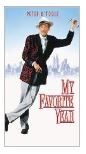
And speaking of which, I encountered a 2016 review of My Favorite Year the other day in which, among other things, recounted the 1997 interview with Mel Brooks and his experience with Errol Flynn on Your Show of Shows. And how THIS encounter became the ultimate seed for a film adaptation.
On the surface, this real life situation as inspiration is certainly plausible, but we’re talking about Mel Brooks here and so, share with you ANOTHER of his “stories” for your consideration and … to make a point:
“I was a corporal in World War II. One day, I took eight guys out on a scouting mission, and we found a box of German rifles. Nearby, there were telephone polls with the ceramic insulators at the top. So I say, “A buck a piece—whoever can knock off the most insulators gets the pot.” We grab the rifles and start shooting. Somebody from Arkansas—they know how to do it—knocked off all of them and gets the nine bucks. When we get back to our base, sirens are going off. Everybody’s running around. I see my sergeant and ask what’s going on. He says, “Communications have been cut off between the 7th Army and the 26th Corps. All the telephone lines are down. We think there are snipers and we’re getting a patrol together to find them.” Now, I’m a little scared. I know exactly who’s at fault. So I said, “Okay, count me in.” And out I went again. We never did find them.
It just got me to thinking that maybe there was STILL another story, and how I ultimately came to find out that My Favorite Year maybe had some “additional” background.
(You see, the details in history OF A TIME shapes art but, with time, tends to recede into the background and though what’s left is still a beautiful stand alone, it’s not ALL of it.)
The REEL story behind the making of My Favorite Year is of an entirely different effort to put it bluntly- it’s a defense of Flynn’s “la mémoire collective” in RESPONSE to Errol Flynn: The Untold Story.
Add to this premise, the idea that Mel helmed the project in a surreptitious fashion such that I really don’t think any one person (other than himself) FULLY grasped his commitment to making a particular film, in a particular way, with a particular end, and without even the seeming desire for any sort of credit. Witness the only mention, in the VERY beginning … and look fast cause you just might miss the mention of “Brooksfilms Ltd.” in the opening credits.
And finally, throw into this mix some additional “flavorings” and, you have a tale that is of its time, “characters” who are reasonably familiar (yet also litigiously remote where applicable), and “borrowings” of places and people.
Penned in 2006 with references that may not all “link” up with contemporary sites of the day, I give you…
.
The Reel Story Behind My Favorite Year
– Dedicated to Clarence Duffy, Benjamin Steinberg, and K. T. Hunter –
By Karl Holmberg
FADE IN:
My Favorite Year is an open love letter to both early television and, more importantly, to Errol Flynn- Mel Brooks style 1. It is also a coming of age film, as involves the main character , Benjy Stone, of the film. But it is to the particular focus on Errol Flynn that I turn my attention, in an attempt to provide an explanation of some kind- one that we’d all been on the trail of for years!
What we did know, from the opening moments of the film, is that My Favorite Year takes place in New York City, N.Y., at the NBC Studios, located at Rockefeller Center, or “30 Rock”- and begins on December 3, 1954 2. What we also know, from a Mel Brooks interview, is the name of the REAL tv show appearance on which the factious one was based. Equipped with these “so-called” facts, I’d been down to the Museum of Television and Radio 3 to see if the Flynn appearance on Your Show of Shows was there … and found nothing. That was a dead end.
Later, checking an archive for Your Show of Shows revealed that it had a run from February 25, 1950 until June 5, 1954. (In case you are wondering, Faye Emerson, a Flynn film alumnus, was the last celebrity guest). What followed this was a DIFFERENT show called Caesar’s Hour which premiered on September 27, 1954- so no match with the above date and show name. Therefore, to reference a date beyond the series end, was a clue- but also, another dead end.
And so it went.
Bits of information came slowly, over the years, and you will see excerpts from these various sources. You will also need some background. There is a reference to The Martha Raye Show. Flynn made 2 appearances and they took place on June 7, 1955 (see synopsis below) and January 3, 1956. I think the former appearance (1955) is the relevent one, because of a “Pirate Story” sequence. However, I must state that I have not seen the other. There was also a January 6, 1957 appearance on The Steve Allen Show in which Flynn and Steve have a sword fight. In the case of the Allen show, I have seen ONLY the sword fight clip itself.
Further, there is the thought that My Favorite Year may well be a composite of IDEAS, actually, from BOTH of these (Raye and Allen) appearances.
And finally, there will also be an attempt to bring it all together, including the speculation that Mel Brooks had a SPECIAL agenda. But let’s begin with picking up some more of the trail.
LONG SHOT:
First of all, here’s what Mel Brooks, in 1997, said PUBLICLY 4:
“Jeffrey Howard: How close was the movie My Favorite Year [1982] in capturing the atmosphere of Your Show Of Shows?
Mel Brooks: Pretty damn close. My company made it Brooksfilm and I made sure that we were telling the truth. I was locked in the Waldorf Towers with Errol Flynn and two red-headed, Cuban sisters. For three days I was trying to get them out of there and he was trying to get me drunk and in there. It was the craziest weekend of my life. I was 20 years old and just starting with The Show Of Shows. He was a tough guy to corral and get to rehearsals. Max Liebman assigned me to him and said, “Get him into rehearsal! Make him learn his lines! Work with him on the sketch!” Errol Flynn was a raving maniac. All he wanted was booze and to fool around. He did learn the sketch. Actually, I whispered into his ear when he was asleep. I’d say all the lines and unconsciously, I knew it would get through to his head.
JH: Were you the character of Herb?
MB: No! I was Benjy. I was the young kid who had to take care of Errol Flynn, but we didn’t call him Errol Flynn, we called him Alan Swann and we got Peter O’Toole to play him.“
Now, contrast this, with what Brooks said in 1982, PRIVATELY, as related in a review of 2002 5:
“Richard Benjamin’s delightful audio commentary to the DVD of his first movie, My Favorite Year 6 , overflows with insights about his actors … Benjamin only breezes through the genesis of this Brooksfilm Limited production—so here it is, as Mel Brooks related it to me in 1982. When a young writer named Dennis Palumbo approached producer Michael Gruskoff with a story about Doc Holliday’s coming to Manhattan to publish a novel and having his ghostwriter squire him around town, Gruskoff had a stroke of inspiration. He said he wasn’t that interested in Doc Holliday or in New York publishing at the turn of the century, but he was interested in Errol Flynn and such live TV comedy series as Sid Caesar’s Your Show of Shows . At the time, Gruskoff didn’t know that in the mid-’50s, when Flynn was still an alcohol-fueled hell-raiser but past his prime and paunchy, he’d guest-starred on The Martha Raye Show .
All Gruskoff knew was that Flynn and Caesar set off sparks in his imagination. Gruskoff set up a meeting with Palumbo and Mel Brooks, for whom he’d produced Young Frankenstein. And Brooks, with his knowledge of the milieu—he’d started out writing for Caesar—agreed to be Gruskoff’s partner and suggested Norman Steinberg (who’d co-written Brooks’ Blazing Saddles ) to do the rewrite. They put actor-turned-director Benjamin at the helm, assembled a cast led by Peter O’Toole as the Flynn character and Joseph Bologna as the Caesar character, and the result, as they say, is “show biz history”—or at least, an immensely human and enjoyable comedy. My Favorite Year is a movie that rises—and sometimes soars—on the beauty of its central idea and on the loving, intelligent way it’s been fleshed out.”
And finally, consider this further CONTEXTUAL background 7:
“Actor Errol Flynn’s off-screen personality was notoriously legendary. Flynn was often depicted as a drunkard with an extremely active sex life (with accusations that ranged from homosexuality to statutory rape), who was consciously destructing himself. In spite of this notorious behavior, there was something about Flynn, most probably his lack of remorse about the way he led his life, that compelled empathy.
This empathy came to a halt around 1980, with the publication of Charles Higham’s “Errol Flynn: The Untold Story”. Higham added another element to the Flynn legend: Backed with evidence from official sources, Higham claimed that Errol Flynn had been an active Nazi spy in the United States. This led to generalized disgust for the actor, his films allegedly disappeared from television, and to even mention Errol Flynn became taboo. In the following decade, Higham’s book would be proved a fraud, but the damage had been done, and Flynn’s best features never seemed to return to their previous level of popularity.
This was the context in which My Favorite Year (1982), Richard Benjamin’s directorial debut, a film which was an obvious parody of Errol Flynn, came out. It made no mention whatsoever of Higham’s controversial claims, as the film was a comedy, mainly about Flynn’s acquaintance with the bottle, but also a nostalgic portrait of television during its “golden age”, the 1950’s. The film was phenomenally popular, earned actor Peter O’Toole a seventh Oscar nomination as best actor (but unfortunately, a seventh loss) and was later turned into a successful musical.
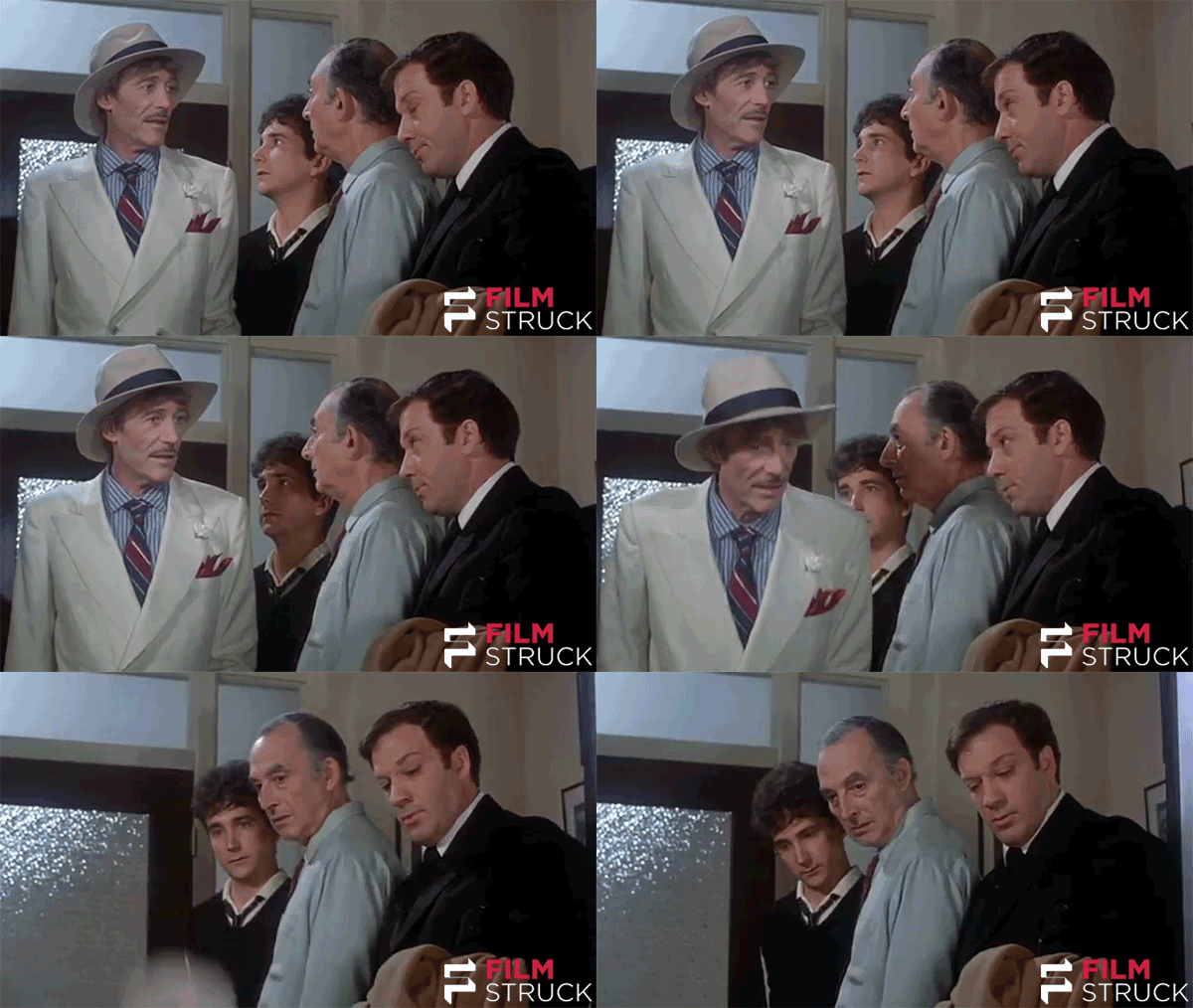
‘In 1954, television was live and comedy was king’, explains Benjy Stone (Mark Linn-Baker), the narrator of the film. In 1954, Stone, modelled on Mel Brooks, was a junior writer for a weekly NBC television show named “King Kaiser’s Comedy Cavalcade”, modelled on Sid Caesar’s “Your Show of Shows”. The guest star for the upcoming episode is supposed to be Alan Swann (Peter O’Toole), a matinee idol best remembered for his swashbuckling films such as “Swords of Glory”, “Defender of the Crown”, “Captain from Tortuga”, and “Rapture”, but who had later turned into a drunken has-been with his days of glory long behind him, with no film prospects ahead of him, and who in fact was threatened with deportation if he did not find a source of revenue, thus the reason for his accepting a guest presence on the show.”
MEDIUM SHOT:
It is curious that Brooks was still perpetuating the SAME STORY as his film depicted, PUBLICLY, in the 1997 interview … but then again, maybe not so strange.
Second, I would like to highlight PARTS of some key sentences from the other interview (of 1982, and PRIVATELY told) with Brooks: “Dennis Palumbo approached producer Michael Gruskoff“ and “Gruskoff didn’t know that in the mid-50s … when Flynn … guest-starred on The Martha Raye Show “, and “Brooks, with his knowledge of the milieu … agreed to be Gruskoff’s partner”.
And third, I think Richard Benjamin, in the aforementioned audio commentary (it was the reviewer who quoted what Brooks said, NOT BENJAMIN) provides, perhaps, the MOST CREDIBLE information of all. And since what Benjamin said didn’t make it into print, I will paraphrase it here: that it was Gruskoff, who approached Brooks with another story, that Brooks wasn’t interested, but that he WAS interested in the appearance of an aging movie star appearing on Your Show of Shows. And sprinkled throughout the rest of Benjamin’s “annotations” was that Brooks had input into the film.
I think it was even MORE than that: Brooks had a PLAN.
Now, are you beginning to get the idea that no matter what he says, Brooks was always attempting to throw people off and send them in another direction? For example, Brooks said that Gruskoff didn’t know Errol Flynn appeared on The Martha RayeShow … but what’s that got to do with anything when it was Mel Brooks’ ORIGINAL idea in the first place, and he DID! It’s not about Gruskoff, and his running the show, but about BROOKS, and his MORE THAN “Executive Producer” involvement!
THE REST of this story fell into place for me with the above Brooks ANECDOTAL interview that came to light in 2002, and then listening CAREFULLY to Richard Benjamin. It was SO CLEAR that Brooks had to have had major CREATIVE input: ”his re-direction of the proposed film project“, “his knowledge of the milieu”, Brooks own “handpicked” writer Norman Steinberg, and Benjamin’s own occasional mentioning’s of Brooks throughout his commentary. And, finally, that it was Brooks WHO KNEW about Flynn’s “Martha Raye Show” appearance- but even that, I will argue, is something of another “false lead” in a way.
Following this so far?
Aside from the MORE THAN obvious Your Show of Shows parallel, there is ALSO the CRYPTICALLY acknowledged “Martha Raye Show“ as an idea of (some?) inspiration. But, as far as this “influence” is concerned, there are only VERY general parallels: the pirate fight scene idea of the Raye Show in the grand finale of My Favorite Year, and when Benjy carries a life size card board cut out of Alan Swann in the early scenes of My Favorite Year- an OBVIOUS borrowing of the “cardboard cut out idea” used in the credits of the Raye’s “Captain Flood On The Spanish Main” skit. That’s about it.
THERE IS NOT a clear delineation of good triumphing over evil in the Raye Show. Also, the fact that the Swann segment of My Favorite Year was to be a “Three Musketeers” skit complete with PLUMED HATS, whereas Raye’s was about pirates. And even Flynn’s “winning”, in this same “Pirate” vignette, somehow anti-climatic.
So it only begs the question: where did the further ideas come from for My Favorite Year ? They could have been thought up, but I put to you this possibility- that the “seed” for at least a PART of this other creative thinking CAME from somewhere else … ANOTHER Flynn live tv show appearance perhaps?
I NOW introduce “the sword fight” segment from The Steve Allen Show where the subtext is of an aging, fading star of a questionably older medium “going up against” a younger, blazing star of a newer one. (I will elaborate on this Allen connection after it has been more fully described). Now THIS delivers some familiar ideas that are a crowning inspiration for a major plot line to the film, and adds something NEW to the story about the film’s making. Namely, THE IDEA that a composite of TWO REAL television appearances lent themselves to the basic storyline of My Favorite Year and cloaked in the guise of a Your Show of Shows setting. PLUS, re-creations of classic (Flynn) film scenes, along with some other “borrowings” from Barrymore, Niven, and even a few true details from Flynn’s own life- not to mention, the WONDERFUL imagination of assembling it all together.
Anyway, back to the Allen appearance. The clip from The Steve Allen Show, included in the documentary A & E’s “It’s Only Talk: The Real Story of America’s Talk Shows”, has an appropriate introduction that underscores, rather UNAMBIGUOUSLY, one point of view (or was it possibly, an unconscious borrowing?) and goes like this: “Carson and all these guys have stolen from him (Allen) like crazy.” Then, roll footage:
Errol Flynn, with drawn sword, is waiting in the foreground of a room (much like the Inn in Adventures of Don Juan). He’s looking about cautiously. Suddenly, from a corner of the room at the top of a staircase, a door swings open, and in steps Steve Allen. They are both wearing the same clothes: white shirt, black pants, and plumed hat. But wait, there IS a difference! Steve’s wearing a black hat and Errol a white. (My Favorite Year has Alan Swann in a similar style hat).
Steve cries out, as if in challenge: “Errol Flynn”.
And Flynn answers weakly: “Steve Allen”.
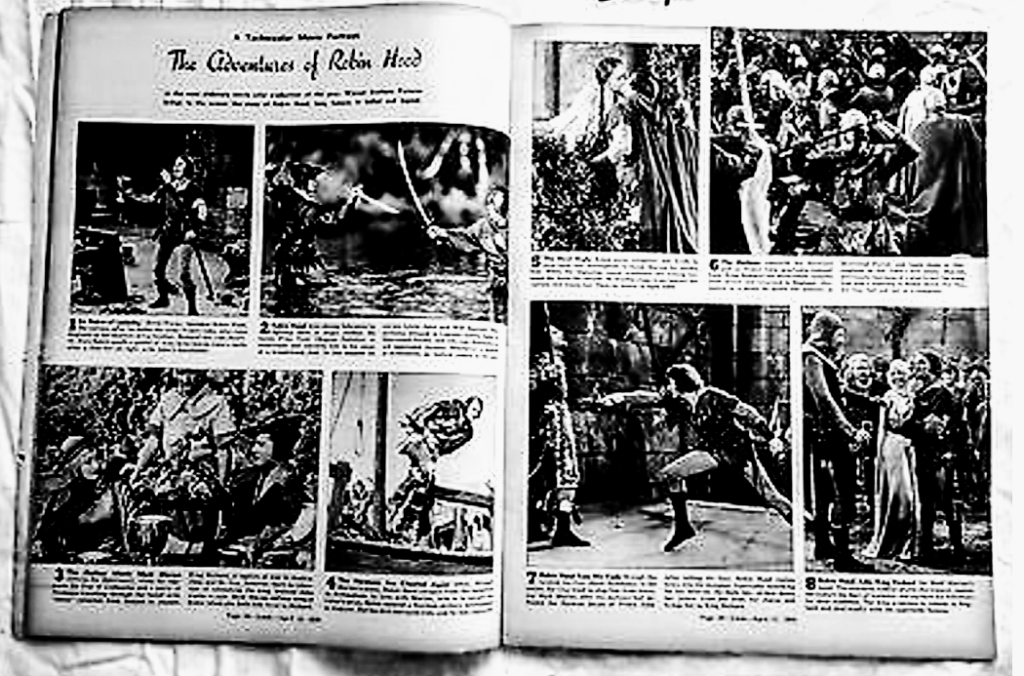
Steve leaps from the staircase, catching hold of a chandelier, swings to the floor, and immediately draws his sword. Steve is the aggressor; Errol startled and seemingly unsure. They begin their duel. Steve fences boldly, though backing up, while Errol is tentative and moving forward. They do a Flynn/Rathbone like banter (as in Adventures of Robin Hood).
Steve begins: “Errol, it’s wonderful to see ya. I understand you’ve been doing quite a bit of traveling lately.”
Errol responds: “Well, yes Steve I have, actually I’ve been in Spain, you know.”
Suddenly, Errol comes alive, and picks up both his pace and technique, and then … knocks Steve’s sword from his hand.
End of clip.
Now, in the sword fight sequence just described, one can recognize some familiar additional elements of the My Favorite Year story. There is the, already mentioned, fading/new star idea, the similarity of attire, particularly the hat, the swinging in from the balcony of Swann (just as Allen did), and the inescapable parallel, in feeling, that it’s not going to be the “white hat” Flynn’s finest moment on television- but then “of a sudden’, the situation turns around and the “black hat”, Allen (Boss Rojeck, as represented by his thugs), is vanquished. Good triumphs over evil, just once more, as in My Favorite Year. It’s a little, almost insignificant moment on television, but this “Alan Swann”, like a Phoenix from the ashes- rises to the occasion as well, just once more.
In talking with a Mel Brooks fan, he spoke to me about another side of the man- that he is NOT JUST as he seems nor creates. And it gave me a new perspective. In thinking about ALL THE ABOVE, it is clear to me now that My Favorite Year was a DELIBERATE act of coming to Errol’s defense. To wit: by creating a fiction as reality (just as Higham), and putting out an even MORE POWERFUL mythic story ABOUT FLYNN into a movie that doesn’t mention him by name, winds up making “a big joke” out of the Nazi / bi-sexual allegations, and putting Flynn BACK into an UNDERSTANDABLE context- all without ever ARGUING a single point.
But Mel will never tell …
All pretty speculative, huh?
Ah, but to remind you of a FURTHER point of information- Higham’s book first came out in January 1, 1980 (and it took only a short while for the GENERAL public to become aware of its sensational contents- THIS fraudulent fiction passing, then, as bona fide biography) and My Favorite Year (final script: September 4, 1981) opened on October 1,1982. A scant 24 months between the first publication of the former, and the premier of the latter. Pretty close in time, all things considered, don’t you think?
I say we have Mel Brooks, the UNCREDITED Executive Producer (Brooks Films Limited being the only HINT at an “official” credit- and listed FIRST) to thank for putting the FACT back into the myth and ALSO producing a wonderful movie at the same time. There were others creatively involved, but make no mistake- it was because of HIM that this film was made, and made the way he wanted it made. REMEMBER, he turned enthusiasm for one ENTIRELY DIFFERENT film idea into enthusiasm for ANOTHER and it was taken in HIS direction, for HIS purposes … and did he succeed?
The final spoken line of Alan Swann provides a possible answer. Swann returns to inside the building of “30 Rock” after initially fleeing when he learns, for the first time, that the program is a LIVE TELEVISION BROADCAST! He encounters Benjy in a hall of the building. And in a most touching moment, Swann admits his fear. Benjy appeals to Swann, and in the process, shifts from his boyhood idolatry (as evidenced throughout the film) into a rousing, impassioned, and ultimately inspiring speech as more befits that of one man (hence, a part of the idea behind title of the film) speaking to another:
“Alan Swann afraid? … Whoever you were in those movies, those silly god-damned heroes- meant a lot to me. What does it matter if it was an illusion- it worked! So don’t tell me this is you life-size. I can’t use you life- size. I need Alan Swanns as big as I can get them. And let me tell you something, you couldn’t of convinced me the way you did unless somewhere in you, you had that courage. Nobody’s that good an actor. You are that silly God damn hero.”
Benjy exits. You next see Benjy in the stage lighting balcony, and he is seeing what everyone else is- the thugs of Boss Rojeck prevailing, in a general free for all, with Kaiser and his cast. Suddenly, Alan Swann appears on the balcony also. He sees his Three Musketeers skit compatriot in trouble and cries out his name. And there is a certain “something” familiar, and yet not so, about this name. Also, there is, in this one word utterance, both a quality that acknowledges his coming to the aid his friend, and that somehow involves himself as well. And what is this name? Well, when Swann says it, it sounds like “Porthold” as I hear it (one of the true names of a Three Musketeers character is ACTUALLY Porthos).
This is a high point- and the whole point really, of this film. In this VERY moment, Swann has not only found the courage to appear on live television, and further, rescue his friend in need, BUT, at this point in this more than CINEMATICALLY argued case, also PUBLICLY ANNOUNCES the re-claiming of his legacy: “Porthole”. 8
Remember, the TRUE deliverer of this message: MEL BROOKS.
Put aside your suppositions and presuppositions about Mel Brooks. THINK ABOUT IT …
I can almost hear now, faintly, IN MY OWN IMAGINATION, a part of a familiar tune- only the words are a bit different. And from the far off distance, it suddenly looms forward- and is now heard:
“ Springtime for Errol and honesty, winter for Higham and lies ”. 9
One kind of a man in public; another kind elsewhere; and then STILL another …
OH YES- and by the way, Mel Brooks succeeded in HIS AGENDA- at least for me.
For a FINAL ending (and something completely overlooked in this analysis) I will give Peter O’Toole the last word.
O’Toole, asked where he put My Favorite Year, within his TOTAL body of work, responded: “Highly”.
“Why?” asked the interviewer Charlie Rose.
(Because it’s) “funny.” 10
CLOSE UP:
Some minor points, further explained. The question mark, at the very beginning, is both a play on the title of this writing, and a variation on the Flynn “squarish” question mark as described in both My Wicked, Wicked Ways and the second Conrad book about Flynn 11. Clarence Duffy and Benjamin Steinberg are the reel, “real” names of Alan Swann and Benjy Stone. Kathryn (K. T.) Hunter is a friend, a Flynn birth day sharer, and someone who has recently had a “coming of age” herself, so to speak. The famous Barrymore line, often attributed to Flynn, is used as a part of Swann’s scene of “this is for ladies only” 12. Niven’s oft-quoted remark about how “he always let you down” 13 was also used. English Repertory 14, the place Flynn first began his acting career, is also referenced, as is The Stork Club, a NYC night spot, where Flynn may well have gotten into a “little” trouble 15. Finally, the movie steered WAY far away from any sort of CLEAR parallel to son, Sean, and Palm Beach, where Sean and his mother, Lili Damita, lived at the time (1954) of My Favorite Year, (because of the still very much ALIVE, in 1982, “Litigious Lil”?) and moved up the coast to a “safer“ Connecticut and a daughter named Tess. And finally …
this story would not have come out into the light and beyond the darkness of a theater- sans the active and helpful discussion with the following people: Lincoln Hurst, David DeWitt, Brian Twist, and Ralph Schiller– along with some good old fashioned physical and etherical “shoe leather”. And also, a special acknowledgement to Shannon Semler– who made the Martha Raye program available for viewing:
Martha Raye Show Synopsis:
On the Martha Raye Show of 06/7/55, Martha (Raye, obviously) and Artie (a girl shy grocer played by Errol Flynn), are sitting on a park bench. Martha wants to be kissed but Artie is slow to catch on. She suggests that he act, like in a movie, where she’s been away for a long time and he’s missed her. This instruction arouses the inner (acting only) man. She stops the progression.
She now suggests a goodbye scene and he cooperates by “acting” even more passionately. Afterwards, Artie is still un-phased by it all (because to him it was ALL acting) while Martha, overcome by all this concentrated kissing, stretches out on a park bench, and says: ” I don’t want to remember as you are, I want to remember as you were: my movie hero.” And abruptly passes out.
As the camera goes out of focus and then back in again, a movie begins. The titles say “Captain Flood on the Spanish Main” and “Starring My Movie Hero”. A narration picks up explaining: ”Early in the 18th century, the waters between Europe and the New World were plagued by bands of marauding pirates …” As the narration continues, a line of “live” pirates are shown, one by one, moving off screen until … “but the most terrible of them all was the infamous Captain Flood.” A life size cardboard cut out picture of Captain Flood (Errol Flynn) is shown.
The visual story is done as a silent film, with appropriate music, broad gestures, accompanying voice narration and occasional dialogue. It opens with Spanish Lords and Ladies (the good guys), dancing on the deck of the Spanish ship, Santa Ana, when all of a sudden, Pirates (the bad guys) come aboard. A fight ensues and both Lords and Ladies go over the side. Flood appears near the end of the skirmish, off to one side (and his costume is in the manner of the classic buccaneer). The pirates are victorious.
Flood speaks: “Show them no mercy men- this is Captain Flood.” He swaggers, in an exaggerated manner, moving about the deck., and then speaks again: “To your feet lubbers.” The Lords now beg aloud for mercy, but Flood declares: “To the sharks with them!” One by one they are thrown over as a back spray follows each of them. As the pirates and Flood look over the side, as the last one goes in, there’s at first the expected spray, but then Flood is hit in the face with an errant, delayed splash.
Suddenly two screaming women, in petticoats, followed by a screaming pirate, emerge from behind a door. Then, an elegantly dressed lady appears announcing: “That will teach you to trifle with Dona Martha (Raye, again), the Queen of Castile.”
Back now to “silent mode” as Dona Martha moves about the deck, walks among the pirates, pausing in front of each, and each in turn, faints- either from her (implied) stunning beauty or debilitating ugliness? She comes to Captain Flood, and she faints, then recovers , and faints again! She comes to but is still weak, and has to be held up by two pirates, as Flood woes her. She’s then carried off, with Flood leading, to another part of the ship for a dalliance.
As Flood is dallying, “Rocky” (Marciano, former Middleweight Boxing Champion, and show regular), the hook-handed first mate, plots a mutiny, still “silently”, with his fellow pirates against Flood. The pirates then respond to the plan with various pirate-like “grunts” of agreement that can now be heard and, when Rocky scratches his throat with his hook , he says so out loud in a child-like manner. Then they all break into a jazzy chorus of “Fifteen Men ”.
Fade out and back in to the final stretch and “unspoken” silence again, where Flood and Dona Martha, gesture at talking among themselves and relaxing against the mast as the mutineers surround them. (Flood now becomes the sole “good guy” to the pirate’s continued “bad guys” role). Flood springs into action, moving Dona Martha to various points of safety as he, single handedly, fights off the crew. It is a well choreographed, slapstick style of confusion and acrobatics, including Flynn dropping his sword and catching it on a bounce (and similar to the My Favorite Year fight scene). At one point, Flood even seems to have stabbed Dona Martha, only she continues moving about. Finally, it comes down to Rocky and his hook against Flood and his sword. As the brief fight unfolds, Dona Martha weaves in and out of the engagement. At one point, Martha even causes them all to link arms and turn about in circular fashion. They all finally break from this entanglement, Flood prevails, and as Rocky staggers, Dona Martha finally HELPS- shouldering him over the side.
Flood and Dona Martha embrace. End of story. (Flynn is clearly tired and winded by skit’s end).
MACRO:
1 Professor Lincoln D. Hurst, PhD, in a 2004 “Friends of Errol Flynn Group” posting, relates the following story: “About three years ago Deirdre Flynn ran into Anne and her husband, Mel Brooks, at the Santa Anita race track. Deirdre said to him, “Oh, so my father had it coming, did he?” She was referring to Brooks’ film “Men In Tights,” for which the ad campaign went, “The Legend Had It Coming.” Brooks said, “Uh, excuse me, but who in the hell are you?” She then told him, and he literally fell to the ground, mortified, and while still on his back screamed, “Oh my God! My God, Deirdre, I LOVE your father! Didn’t you know that was meant as a loving tribute to him?”
2 The Daily Mirror, a front page headline, in one of the early scenes of the film, reads: “Joe Blows It”. This headline, as best as I can make out, refers to an event which took place on December 2, 1954 in which the U.S. Senate voted to condemn Senator Joseph R. McCarthy for conduct unbecoming of a senator. This condemnation, which was equivalent to a censure, related to McCarthy’s controversial investigation of suspected communists in the U.S. government, military, and civilian society.
3 The Museum of Television and Radio, 25 West 52nd Street, New York, N.Y. From the website description: “It has over 120,000 programs and advertisements, covering more than eighty-five years of television and radio history (beginning with a 1918 speech by labor leader Samuel Gompers). The collection spans all genres: comedy, drama, news, public affairs, performing arts, children’s, sports, reality, animation, and documentary, and includes a significant international presence, with seven thousand assets from seventy countries. The same collection is available in both New York and Los Angeles.” And “It is a curated collection. Programs have been selected on the basis of artistic achievement, social impact, or historic significance.”
4 Jeffrey K. Howard, “Lost Issue Wednesday: Mel Brooks Interview”, 1997, internet source: www.filmscoremonthly.com…
5 Michael Sragow, “Review (the DVD release) of My Favorite Year”, October, 2002, was, at one time, available on an internet source called the AV Guide site through this link: www.avguide.com… . I could not find an updated link. A professional reviewer, Michael Sragow has been a film critic for publications in Los Angeles, San Francisco, Boston and Seattle. He has been a staff writer for The New Yorker and Rolling Stone, and has had articles in several top publications. He went to the Baltimore Sun in 2001 from Salon.com…, and more recently, to the Orange County (California) Register. Editor of several books and author of Victor Fleming: American Movie Master.
6 My Favorite Year, Warner Home Video, 2002 (DVD). Runtime: 92 minutes. Plus Richard Benjamin audio commentary.
7 Alexandre Paquin, “Review of My Favorite Year”, 7/30/01, (from Montreal, Canada) originally on Epinions.com…, internet source: www.epinions.com… (this link is no longer accessible), but the review, itself, has survived and moved over to Efilm Critic: efilmcritic.com…
8 The association of “porthole” is in connection with the statutory rape trial- and a MAJOR turning point in Flynn’s life. It was a part of the testimony of one of the accusing women who claimed to have seen the moon, through the Sirocco cabin porthole, around the time of the alleged rape. This “association” captured the imagination of the public in 1943- and even beyond. So much so, in fact, that in his final public appearance, of 9/29/59, Flynn references “porthole” in the course of a comedic skit. Besides the writer, THIS FINAL FROLICKING moment did not escape the attention of Brooks either, in his MOST MAGNANIMOUS effort to reset the Flynn legend BACK to this VERY point- and BEFORE the Higham book.
9 Karl Holmberg, his own “ironical” variation on a part of the chorus of the song : ”Springtime For Hitler”, from the Mel Brooks film, The Producers, 1968.
10 Peter O’Toole, as quoted from his appearance on The Charlie Rose Show, PBS, 12/19/00.
11 Earl Conrad, Errol Flynn: A Memoir. Dodd, Mead & Co., 1978, p. 10.
12 Margot Peters, House of Barrymore. New York: Alfred A. Knopf, 1990, p. 593
13 David Niven, Bring On The Empty Horses. New York: Dell Publishing Co., 1975, p. 112
14 Errol Flynn (with Earl Conrad, UNCREDITED ghostwriter), My Wicked, Wicked Ways, New York: Dutton, 1959, pp. 181-187.
15The Los Angeles Daily News, one of the front page headlines: “N.Y. nightspots warn Bogart, Flynn”, and part of the text reads: “… they will be given the “bums rush” the next time they enter a New York restaurant or nightclub to ‘get stiff and raise hell’, the Society of Restaurateurs said today…”, 11/10/49.
FADE OUT:
— David DeWitt