RSS
 

Search results for ‘name’

Hi-Tailing It to Texas

30 Dec

Fleeing Hollywood for the Mexican border

December 29, 1939

SAN FRANCISCO CHRONICLE
Jimmie Fidler

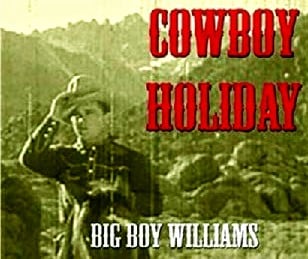
Errol Flynn will vacation on Big Boy Williams’ paternal ranch near Del Rio, Texas.

Del Rio – The Friendliest Little Border Town in Texas – An Oasis in the Desert”
amp-southernliving-com.cdn.ampproject.org…

“Travelers have long been drawn to this oasis on the Rio Grande. The American Indians who inhabited the area more than 4,000 years ago left detailed pictographs on cave walls, now a sort of primitive history book etched in stone. Spanish missionaries planted a church here in 1635 and christened the spot San Felipe del Rio. It was named not for the Rio Grande but in honor of San Felipe Springs, which still offers up to 90 million gallons of spring water every minute.”

“Queen City of the Rio Grande”
www-mysanantonio-com.cdn.ampproject.org…

“The heyday of Del Rio, the “Queen City of the Rio Grande,” as year-round tourist destination, along with nearby Villa Acuña, Coahuila, appears to have been in the 1930s.

During that era, the two sister cities straddling the Texas-Mexico border enchanted businessmen and the leisure class with mix of oasis relaxation and unregulated foreign intrigue.”

— Tim


“Columbus” Discovers Flynn — Sends Him to America

01 Dec

NOVEMBER 30, 1934

EVENING HERALD EXPRESS
JIMMY STARR

Irving Asher, Warners’ London laddie in charge of the foreign studio, played “Colombus” and discovered a handsome Irish chap by the name of Errol Flynn .  The young newcomer proved himself in Murder at Monte Carlo. 

Asher figured Flynn had a better chance in Hollywood, and sent him to Jack Warner, who took a quick look at the English-made movie, snapped a contract under his nose and gave him one of the featured leads with Kay Francis in A Present from Margate, her next film following the current Living on Velvet. 

Mr. Flynn it seems has made quite an impression— and good leading men are scarse, you know.

Was it Asher? Or Doug Jr.? Or JB?

books.google.com…

Asher and Warner found gold in England when the found Flynn. The public really dug Errol.

— Tim


Oh, O-Han-Zee!

22 Nov

In Celebration of Thanksgiving and the Native American Annual Harvest

COMFORTING SHADOWS IN CENTRAL PARK, 1941

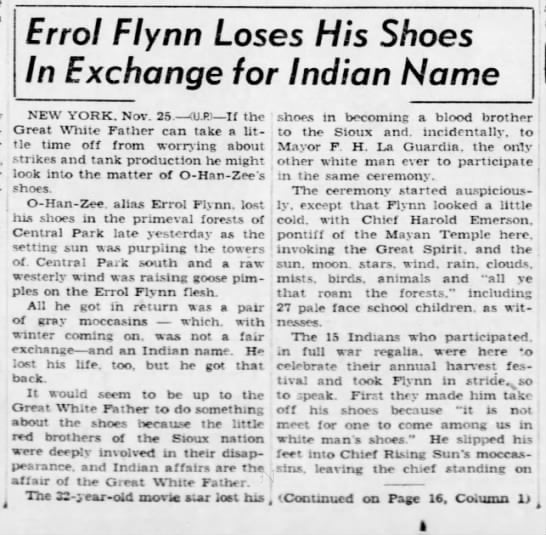
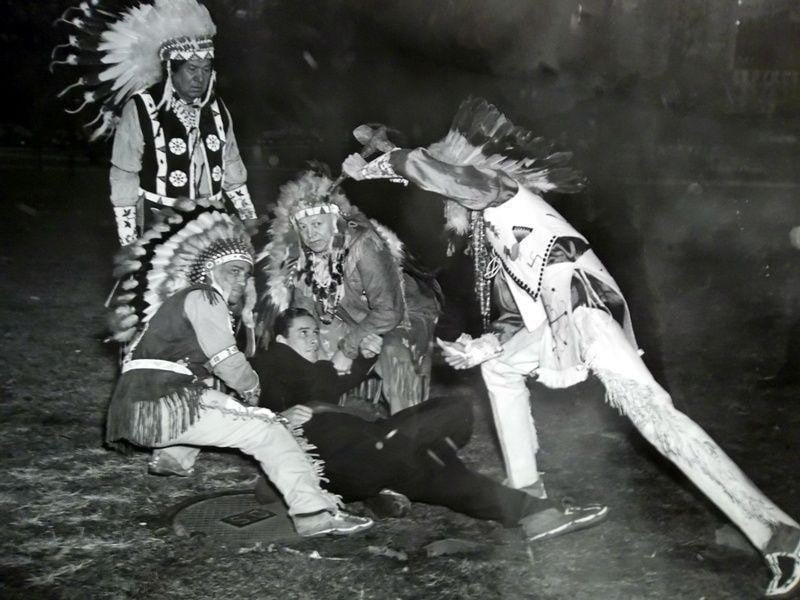
Indians Adopt Errol Flynn. New York: “Movie actor Errol Flynn has to undergo a ‘tomahawking’ during the ceremony marking his adoption as a member of the United Sioux Tribe at the Indian’s Annual Harvest Festival in Central Park (Hechsher Playground) New York November 24. Named ‘Comforting Shadows’, Flynn is one of two notables ever to be given this particular adoption. It made him blood brother of Mayor Fiorello LaGuardia of New York City.”

ERROL GETS SIOUXED AND LOSES HIS SHOES

— Tim


Meeting Deirdre

20 Nov

Fifteen years ago I hired Deirdre Flynn to appear at a Q&A before a showing of Warner Bros’ 1938 version of Robin Hood at Carmel’s Outdoor Forest Theater. I owned a national consumer products business and was forever looking for fun ways to promote the products. When someone approached us to sponsor a film at the Forest Theater, I agreed, providing, I cautioned, it was Robin Hood and providing they let Flynn’s daughter Deidre introduce the film after a Q&A on stage. They readily agreed, and after some doing, I managed to contact Deirdre through a Flynn website in Los Angeles. Nice guy ran it, forgotten his name.

About a month later she arrived in Carmel and it was a delight to meet her. She was soft spoken and friendly with no ego. It was apparent she’d had a hard life. We’d advertised the movie and the Q&A locally, and out of the woodwork appeared Deirdre’s former step sister, the daughter of Joanne Dru, whose father was Dick Haymes. I think we all got together for drinks first in town, and after a shy minute or two the women began to laugh and reminisce.

That night we got to the theater early and I spent some time with Deirdre talking about her dad. I asked whether he’d been a good dad, in her opinion. She said that he had, and that although she had nothing to compare it to, he seemed solicitous and concerned about her. According to Deirdre, from location Errol used to send her letters asking about her homework load, what she was reading, boyfriends. She said he’d sometimes add vocabulary words to the letters he sent, for her to look up and commit to memory. Well that’s something, I thought.

The whole affair of meeting Deirdre was bittersweet, because clearly Errol hand’t been the best father and it seemed sad that his beautiful daughter was drifting thru life as a consequence. The Q & A and movie were a huge hit, however. I remember two things. One, when the audience was told over the loudspeaker that before the film, there would be a Q&A with Errol Flynn’s daughter Deirdre Flynn, the audience actually gasped; they were that enthralled. Second, I was seated beside Deirdre and at the iconic moment in the film when Errol makes his appearance, leaping over the felled tree on his white stallion to the rousing Wolfgang Korngold score, the audience screamed and cheered, and I saw tears of pride and joy appear in Deidre’s eyes as she watched her father up there. I’ll never forget it.

One footnote. There was a raffle before the Q&A, and one lucky audience member received an autographed copy of Errol’s My Wicked Wicked Ways. For a lot of reasons not the least of which was that Flynn died when his book was still in galleys, they didn’t get an actual autographed first edition, but a 1984 paperback edition with an ersatz autograph. In my writing.

— TJR McDowell

 
6 Comments

Posted in Main Page


Mail Bag! Register on this Blog!

17 Nov

We got an email today saying our Registration process is a bit muddy! I think this is the result of different browsers at work, but let’s go over it:

Basically, it is a two step process:

Click on Register on the far right-hand corner of the blog, under Meta.

You will be presented with a WordPress Security Popup that asks you to input the temp username: errolflynn, with temp password efb.

Click Submit to got to the WordPress login page and enter your details.

You will receive an email confirming your registration.

After this, the popup will also appear whenever you log back in, and are sent to your normal login page!

Note: registering for the RSS Feed is not where you register to become a member of the blog, a common error …

— David DeWitt


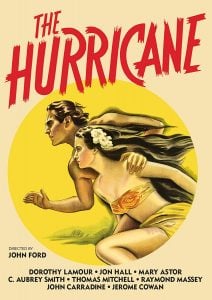
The Hurricane

15 Nov

While it’s still hurricane season here in the U.S. …

LOS ANGELES EXAMINER – NOVEMBER 16, 1936

by LOUELLA O. PARSONS

Bargaining, I hear from a reliable authority, is going on between the Warner Brothers Studio and Samuel Goldwyn. Sam wants Errol Flynn for the lead in Hurricane and offers in exchange William Wyler, the director, and any other bit of property loose on the Goldwyn lot. First time I ever heard of a star being swapped for a director or vice versa. But Wyler is an ace director and is as valuable in his way as Flynn.

Not only has Sam set his heart on Flynn, but John Ford, who will direct for Goldwyn, also has the same idea. And talking about goofy trades, Ford agreed to direct Hurricane on condition that Sam buy him a boat and equipment to film exteriors in the South Seas where he is now vacationing. Margo, who is superb in Winterset, will probably get the lead opposite Flynn, with Basil Rathbone set for an important role.

COULD THIS HAVE BEEN A GREAT ONE OF FLYNN? I believe so. With Wyler directing and the film earning three Academy Awards, but ultimately hampered by the casting of Jon Hall. Errol, IMO, could have lifted this to a Hollywood classic.


Plus, there could have been some very good amour between Flynn and Lamour!

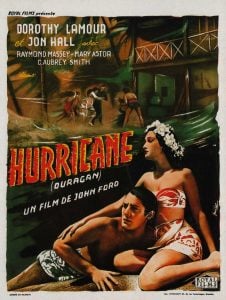
“The Hurricane is a 1937 film set in the South Seas, directed by John Ford and produced by Samuel Goldwyn Productions, about a Polynesian who is unjustly imprisoned. The climax features a special effects hurricane. It stars Dorothy Lamour and Jon Hall, with Mary Astor, C. Aubrey Smith, Thomas Mitchell, Raymond Massey, John Carradine, and Jerome Cowan. James Norman Hall, Jon Hall’s uncle, co-wrote the novel of the same name on which The Hurricane is based.”

The film was nominated for three Academy Awards, winning in the category for Best Sound.
Best Sound Recording – Thomas T. Moulton
Best Supporting Actor (nomination) – Thomas Mitchell
Best Music, Score (nomination) – Alfred Newman

New York Times critic Frank S. Nugent praised the climactic special effect created by James Basevi, stating, “It is a hurricane to blast you from the orchestra pit to the first mezzanine. It is a hurricane to film your eyes with spin-drift, to beat at your ears with its thunder, to clutch at your heart and send your diaphragm vaulting over your floating rib into the region just south of your tonsils.”

He complimented the performances of all of the principal actors with the exception of Hall, whose Terangi was described as “a competent Tarzan”. He also faulted the uneven pacing, but in the end, characterized the film as “one of the most thrilling spectacles the screen has provided this year.”

youtu.be/CatmKnFtn-c…

— Tim
 

Mail Bag! Charge of the Light Brigade and Wiggling Toes!

12 Nov

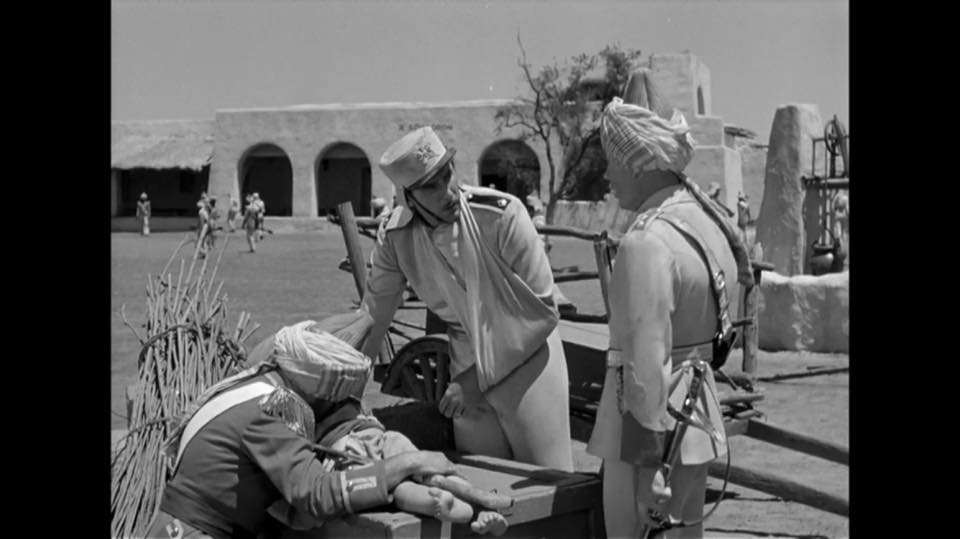
This from Joe Maletta who points out a blooper in Errol’s Charge of the Light Brigade:

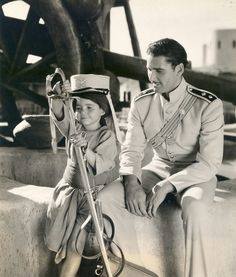
Joe Maletta One of Flynn’s best! The young boy is Scottie Beckett who played Perma the son of J. Carrol Nash’s character. Puran Singh. There is a film blooper when Puran finds and holds his dead son after the massacre at Chukoti. Flynn is trying to console him and as he is doing so, the “dead” son is Wiggling his toes! A little levity aside during a sad moment.

Thanks, Joe!

Scottie Beckett with Errol

— David DeWitt


The Errol Flynn Blog Migration in November!

01 Nov

Mail Bag to The Errol Flynn Blog from our hosting outfit at PressHarbor:

“Thank you for your patience, at last we are ready to begin migrations of all accounts to our new hosting platform.

“Our new platform will continue to be based on Plesk, so all of your existing accounts and passwords will migrate as-is, but this newer version of Plesk and the underlying hardware, software, and infrastructure updates will offer:

– increased security
– improved and guaranteed performance
– free SSL certificate via Let’s Encrypt
– more current versions of PHP

There’s more to come, especially for those of you with multiple sites, but the first phase will be to migrate all sites to the new platform by the end of November.”

The migrations are set to begin November 3, until the end of the month, and we do not yet know what dates our blog will move but we will get that information before it actually happens, I think. It will involve changing our dns server information for our domain name so if, one day, you cannot reach the blog, this will be why. I am told content creation might be interfered with during the the actual move, so let’s all be aware of the the situation and I will keep you as updated as possible …

— David DeWitt

 
1 Comment

Posted in Mail Bag


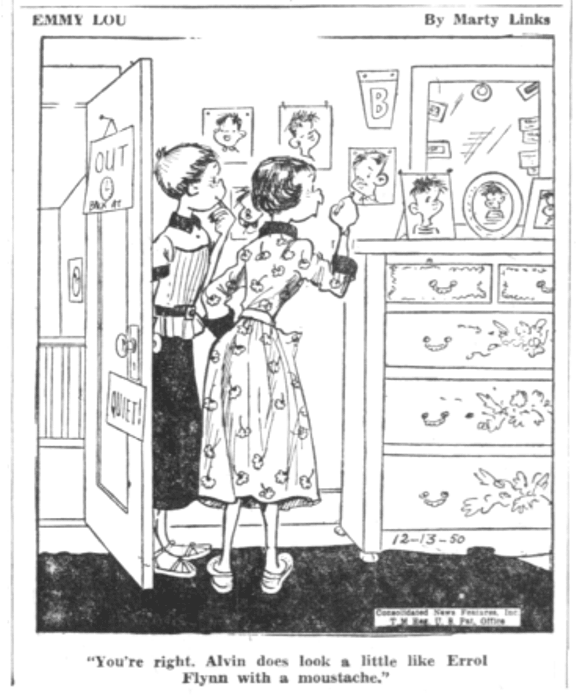
Emmy Lou lives Errol Flynn!

06 Oct

Marty Links who did the pipular series Emmy Lou in the 50’s was actually a woman named Martha B. Links. Belown from Wikipedia is a description of how she worked on the series.

When I first started with the syndicate, I drew only daily panels. After we sold to a few papers, they asked for a Sunday page. This was impossible to handle alone, so Jerry Bundsen and Ted Martine came into my life. Jerry, who works for The San Francisco Examiner with Herb Caen, the columnist, has been writing my daily gags for 11 years. Once a week, he sends me a large batch of gags from which I select what I want and like. If there aren’t enough to make up a week, I fill out with my own ideas—which drives Jerry mad! He claims if he sent me 60 gags I would be unable psychologically to select more than four out of the bunch. This isn’t so at all. After selecting the four best gags, I pencil in the whole week of dailies. These go to Ted Martine, the world’s best artist. (I should be working for him.) He inks in all the pencilled backgrounds. When they are returned I ink in the figures. I have pencilled them in rough enough so that I change as I go along. This keeps the action loose and fresh. In addition, I draw from models constantly, then use the sketches as reference. With the outlines of the furniture inked, for instance, I add details like prints and upholstery, flowers in bowls, fringe on curtains, etc. My husband claims I can’t stand a plain white space. But it’s this detail which gives a homey touch. As a matter of fact I draw all the furniture in our home. I often think I’d like to recover the worn upholstery in a Popsicle-colored background so the Popsicle stains will not show. As to the Sunday panels, these I dream up myself, and it is more work than everything else put together. I feel each idea is the last one I’ll ever be able to eke out. Also I meditate (or should I say brood?) on my own girlhood, which was a long time ago, believe me. But once the mind starts going back, it’s amazing how much it remembers.

The pilot for a proposed series based on Emmy Lou aired as a second-season episode of Mister Ed. The role of Emmy Lou was played by Noanna Dix. Her parents were played by George O’Hanlon and Jeff Donnell.

By the time her children became adults, Links felt the strip no longer represented teens, as she told columnist Caen, “Everything I know about teenagers today is unprintable.” Thus, she brought Emmy Lou to an end in December 1979.

— David DeWitt

 
1 Comment

Posted in Main Page


7th Michigan, CHARGE!

01 Oct

Flynn and Custer, a perfect match – brilliant, discipline-proof, dashing, and destined for greatness.

THEY DIED WITH THEIR BOOTS ON
(Benton Harbor News-Palladium, December 29, 1941.)

Monroe- The premier of the motion picture “They Died With Their Boots On” depicting the career of General George Armstrong Custer, was shown here Sunday. Seven members of the Custer family residing here attended the performance. Brigadier-General Custer, slain in the Battle of the Little Big Horn, attended school and married here.

ERROL FLYNN PLAYS GEORGE CUSTER
(Benton Harbor News-Palladium, January 10, 1942)

Custer’s last stand is an epic of the old west, but the rest of Custer’s life is a Michigan story. As shown in They Died With Their Boots On, the new Errol Flynn, Olivia de Havilland film opening Sunday at the Liberty, George Armstrong Custer’s adventures were intimately concerned with his native state.

He made a name for himself in the Civil War at the Battle of Gettysburg depicted in the film by leading a series of charges by gallant Michigan regiments. Thrown back time and time again, they kept up the fight under his inspirational leadership and finally turned the tide of battle.

After the Civil War ended, Custer like so many brilliant young officers of the Union Army, was retired. A peacetime Army had no use for the vast number of officers developed by the war. Young General Custer settled down with his wife in their native Monroe, Michigan, to live a life of peace.

It was from the same Monroe that Custer had gone before the Civil War to become the most discipline-proof cadet that West Point had seen in years.

According to the film, the most famous song of Custer’s Seventh Regiment, the Gary Owen, was taught to the General in Monroe by an English soldier who was a Union veteran. When the regiment rode forth in battle on the Little Big Horn, the song Custer learned in Monroe, sped them on their way.

George Custer was only 37 when he died. Life in Monroe had bored him. In order to get back into active Army service, he accepted colonel’s rank. He was sent to the most dangerous territory in America, Sioux Country. The Indians called him “Long Hair.” The tribute they paid him in his last stand shows the esteem in which he was held, even by his enemies. Every man killed in the battle was scalped – except Custer.

GENERAL CUSTER AFYER 45 YEARS
(Detroit Free Press, June 27, 1921)

It has been remarked that George Armstrong Custer’s chief contribution to the history of his country was his personality. Such a statement looks like a truism, but in his case it was more peculiarly true than in most. An operose, impetuous spirit, his tepidity, his dash, his verve, has passed into legend while there are still people living in these states who thrill to the memory of the day when Custer fell, who remember the clash of opinion that arose before his gallant blood had cooled.

The forty-five years that have passed since June 25, 1876, have not settled the argument. Was Custer’s death with his three brothers, his nephew, and all of the old fighting Seventh Michigan Cavalry , due to mis-wisdom, an untutored impetuosity, or were the trap and the barbarous slaying inevitable? How much of the mistake can be placed on the two commanders under him, Benteen and Reno, and was the natural indignation of the country justified? The exact facts are obscure, for we are unwilling to accept the only evidence which came from an Indian.

The significant thing now is that Custer’s story is not allowed to die – it is too romantic, too fraught with the perilous spirit of the frontier days which have rapidly dimmed and receded. The story has been woven into pageants, it has been vividly acted before the camera in its own historic setting. Today, out in Hardin, Montana, it is being commemorated again, re-enacted with Indians, some of whom are from the fierce tribe of Sitting Bull. Tamed now and submissive, forgetting the hot rage of the warrior, they are acting for the pleasure of the conqueror and perhaps for the lost glory of their tribe, scenes which were part of the destructive tide that swept them from their last entrenchments in the badlands of the prairie.

What history will do with Custer a hundred years, hence it is impossible to judge; it is probably that no matter what the historian of the future makes of his case he will be handed along in the legends which gave the thrill to cold facts as the perfect cavalry type, the temerarious General of Horse. The nation will remember him as Edward Clark Potter has pictured him when in that significant moment during a lull in the Battle of the Little Big Horn, he spurred forward from the line, and hat in hand, his golden curls flowing from a head thrown back, he stood for a moment surveying enemy lines. His striking uniform, his youth, his daring, combined to make him a glorious, a charmed figure.

The nation will remember him too, however much they may doubt his judgment, as the general who immensely brave, immensely daring, overpowered twenty to one, stayed with his men and died fighting in place. They will honor him as the Sioux honored him, Sitting Bull’s warriors who killed him but held his body inviolate because he was a warrior of whose prowess they stood in awe.

CUSTER’S LAST GUIDON

— Tim