Thank you, Errol.
— Tim
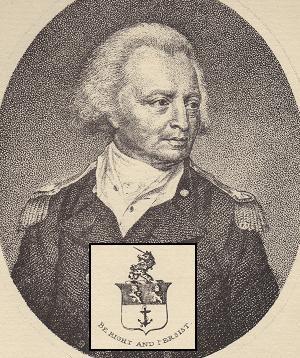
What relation, if any, did this above-depicted man have to Flynn?
— Tim
Dear fellow Flynn fans,
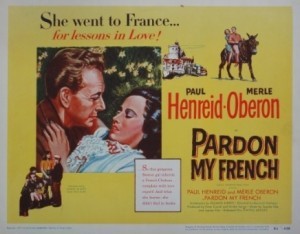
what do you make of the submarinan legend, that Errol can be spotted in the 1951 film “Pardon my French” starring two Flynn(ti)mates Paul Henreid and Merle Oberon?
He supposedly philmbombed a scene at the Harbour while on his way to his ZACA sporting the full beard from “Kim”.
After solving our Hollywood hero`s whereabouts as “Lord of Shanghai” in more ways than one: www.theerrolflynnblog.com…, the new task can only be to view the film and pinpoint the swaying swashbuckler.
The movie as such may have given him the idea of filming “The adventures of Captain Fabian” aka “The Bargain” aka “Bloodline” in the South of France.
PMF was shot in two versions. The second one being a French one, as was categorically required for foreign film companies by the French film authorities, which in turn provided homegrown actors and financial support.
Cap Fab deliberately fell short of these accordance and this contributed to many woes for Errol later on.
He had nothing to gain from this bargain and then he fell for William Tell…
Enjoy,
— shangheinz
Gene Ingram, our member, wrote the following comment on the blog:
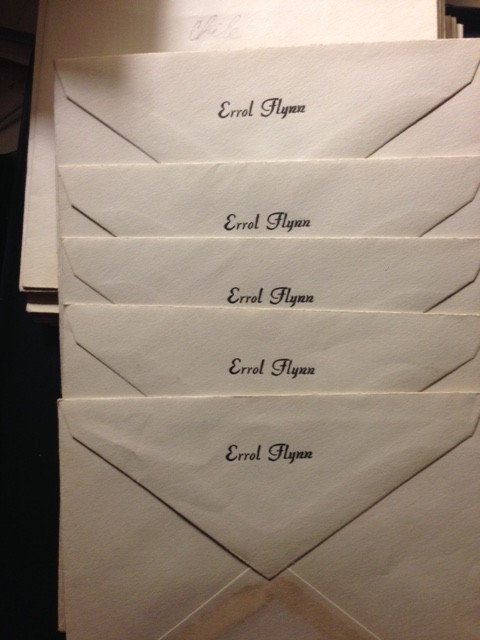
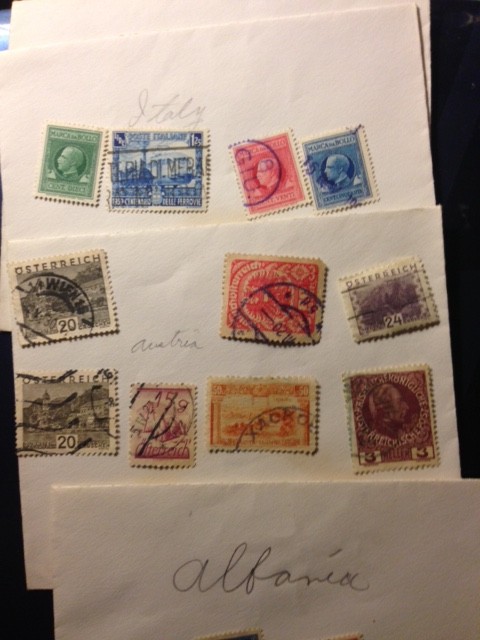
“Quite awhile back I had some dealings with an old gentleman that dealt in stamps and Errol had sent him a great number of 4 X 5 envelopes with his name printed on the back flap, in pencil on the front were several countries in Europe and South America inside were stamps from the 1940’s, the gentleman would then send them to Errol when he had collected a great number. I still have 27 of the envelopes and there are close to 100 stamps in them. The envelopes are the real deal, I don’t think anyone would go to the trouble of having them printed up , them collecting a bunch of WW II era stamps and filling them, and selling them for what I paid for them! I would add a picture but at 73, I am not that good at posting more than the printed word.”
I asked if he could get the photos to us, I’d love to see them, and he kindly sent me the following photos!
Thanks so much, Gene!
— David DeWitt
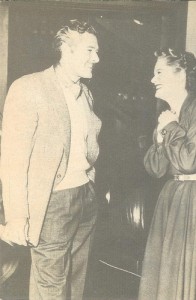 Both Warner Bros contract stars and good friends Errol Flynn and Alexis Smith were loaned out to MGM to star in different films in 1949: Flynn in, ”THAT FORSYTE WOMAN” and Alexis in, ”ANY NUMBER CAN PLAY”. While there they would meet in the commissary, They found few people would talk or say hello to them. They were surprised how cold and unfriendly MGM was VS. WB. They were glad when they had the opportunity to see each other while both were making a film there. Here is a candid photo of Flynn as Soames and Alexis as
Lon Kyng. The photo speaks for itself.
— Kevin Wedman
Dear fellow Flynn fans,
here is one role Errol was practically sea- born for.
Heck, even Jack Warner had suggested our Hollywood hero for the role of the daring navigator 10 years prior to the 1951 version with Gregory Peck.
It is easy to envision our Hollywood hero as commander of the 7 seas and steering his career back on course.
Watch the whole movie here:
putlocker.is/watch-captain-horatio-hornblower-rn-online-free-putlocker.html…
Enjoy,
— shangheinz