I have been doing some home work and research on “The Adventures of Robin Hood” epic film. I like to share it with you in case you were not aware of these trivial facts to some people but important to the blog members. These facts come from various sources! By the way, the feature photo which I thought was a good idea at the time of writing I found somewhere on the internet in case anyone wishes to know!
During one fight sequence, Errol Flynn was jabbed by an actor who was using an unprotected sword–he asked him why he didn’t have a guard on the point. The other player apologized and explained that director Michael Curtiz had instructed him to remove the safety feature in order to make the action “more exciting”. Flynn reportedly climbed up a gantry where Curtiz was standing next to the camera, took him by the throat and asked him if he found that “exciting enough”.
At 28, Errol Flynn was the youngest actor to play Robin Hood.
While filming Robin Hood’s escape from the castle, Basil Rathbone was knocked down and trampled by extras, causing a spear wound in his right foot that required eight stitches to close.
Although shot in California, indigenous English plants were added and the grass was painted to give a greener, more English look.
Howard Hill, who is listed in the credits as “Captain of Archers”, also played “Elwyn the Welshman” in the archery contest. Hill actually made the shot where we see one arrow split another and he did all the shots which required hitting human targets. He also worked closely with the sound department to produce the distinctive arrow sounds by using specially made arrows.
The production used all 11 of the Technicolor cameras in existence in 1938 and they were all returned to Technicolor at the end of each day’s filming.
The sound of Robin’s arrow is the favorite sound of Skywalker Sound’s Ben Burtt. He has used that sound in almost all the Star Wars films.
The Sir Joseph Hooker Oak (called the Gallows Oak in the film) where Robin Hood forms his outlaw band was supposedly the largest living oak tree in the world at the time of filming in 1937. The rock that Errol Flynn stands on in front of the tree is a prop.
Erich Wolfgang Korngold was invited by Warner Brothers to come from his native Austria to Hollywood to see the film with a view to scoring it. He initially turned down the chance, as he felt that his musical style was ill-suited for adventure spectaculars. However, while in Hollywood he learned that the Nazis were about to invade Austria and, feeling he had to secure a source of revenue in the United States and also get his family out of Austria before the invasion, he accepted the assignment. He would go on to win the Oscar. For the rest of his life, Korngold, grateful that this successful assignment allowed him to stay in America and be safe from the Nazis’ murderous persecution, would playfully quip, “Robin Hood saved my life.”
The stunt players wore heavy padding underneath a steel breastplate overlaid with some balsa wood to absorb the impact of arrows.
At the time Olivia de Havilland rode the palomino, its registered name was “Golden Cloud” and was owned by Hudkins Stables, an outfit that leased horses and Western equipment for films. Roy Rogers bought “Golden Cloud” for $2,500. Character actor Smiley Burnette, who was Rogers’ sidekick in his early movies, suggested the name of Trigger, as the horse was “quick-on-the-trigger”. Rogers rode Trigger in his first starring Western, Under Western Stars (1938).
Despite his flamboyant performance as Robin Hood, Errol Flynn privately professed that he found the role a boring one.
Maid Marion is never referred to by that name in this film. She is referred to as “Lady Marion Fitzwalter” twice, once in the banquet scene and the second time by Sir Guy just before she hands the Golden Arrow to Robin Hood.
The third of eight films to feature Errol Flynn and Olivia de Havilland.
James Cagney was the studio’s original choice for Robin Hood. However, when Cagney walked off set, the film’s producer Hal B. Wallis made the decision to cast Errol Flynn, against the studio’s wishes. It was also Wallis’ decision to keep Maid Marian, when the original scriptwriter wanted to dump her character. Wallis felt Marian was an indispensable fixture of a Robin Hood adventure.
Originally budgeted at $1.6 million, the budget ballooned to $2 million, the most expensive Warners film up to that time. However, it turned out to be the studio’s biggest money-maker of 1939, making back far in excess of its cost.
All of the bows and arrows used in the film were hand-made by expert fletcher and archer James Duff of Jersey City, NJ. Duff was an immigrant from Scotland and author of a book of poetry, “Bows and Arrows” (1927).
According to TCM host Robert Osborne, the film was so successful that a sequel was commissioned. However, the US government wanted to restrict the amount of money invested in filmmaking at that point in anticipation of joining World War II, so it was delayed. By 1945, when the war was over, the project was scrapped because Olivia de Havilland and Claude Rains were no longer employed at Warner Bros.
William Keighley had directed Errol Flynn the year before in The Prince and the Pauper(1937), which had turned out well for Warner Brothers. The studio had high hopes for this second teaming, but upon viewing the dailies coming in from the location shoot in Chico, California, they found the action scenes to be lacking in vigor and excitement.Michael Curtiz, who had effectively made Flynn a star with his agile handling of the actor in Captain Blood (1935) and cemented his reputation as a swashbuckling hero in The Charge of the Light Brigade (1936), was brought in to complete the picture. Consequently when Keighley returned to Hollywood from Chico, he found himself out of a job. Ironically, Keighley and Flynn got along quite well, but Curtiz and Flynn despised each other.
The preview audience reaction was so positive that the film was released without any alterations to the plot.
In an effort to assuage the Production Code Administration, aka the Breen Office–which was the official censorship authority at the time and was coming down especially hard on Warner Bros.’ popular gangster films—the studio gave the go-ahead for this project, figuring that a harmless historical tale wouldn’t cause them to run afoul of the censors.
Maid Marian is not from an original Robin Hood ballad but a French romantic ballad, “Jeau Robin et Marian” (“Play of Robin and Marian”). Robin was not a former nobleman but a shepherd, and Marian was a shepherdess whom he loved.
The role of Will Scarlett was originally intended for David Niven, but he was vacationing in England at the time, so the part went to Patric Knowles.
At the time this film held the distinction of employing the largest number of stuntmen on any one production.
Errol Flynn was not happy when Michael Curtiz was assigned to the film, as he didn’t care for Curtiz’s dictatorial methods and the two clashed often while filming The Charge of the Light Brigade (1936), especially over what he–an avid horseman–saw as Curtiz’ indifference to the injuries and deaths of many of the horses used in the film.
Two scenes–a jousting tournament and a christening–were cut from the script to save money and were never filmed.
Although this movie carries the VITAPHONE trademark, in fact, the sound was looped onto the film by a sound-on-film process. This was the result of Warner Brothers having to carry the trademark of the obsolete process until it expired.
The studio files/records for this film are archived at the USC Cinema Television Library. Interoffice memos clearly indicate that Olivia de Havilland was not the first choice for the role of Marion. The original actress, whose name is blacked out in each of documents, became pregnant out of wedlock, and could no longer accept the role.
Olivia de Havilland has only one scene in which she is not wearing a headpiece.
Eugene Pallette was not the first choice for the role of Friar Tuck. Guy Kibbee was originally slated for the part.
For the film’s initial release in May 1938, an unusually elaborate, eight-minute, full-color trailer was produced, which unfortunately does not survive in the Warner vault. Only the reissue trailer (1948) is available now.
On May 11, 1938, a special live radio broadcast of an extended selection of the important parts of the music score by Erich Wolfgang Korngold was presented by NBC coast to coast, with Basil Rathbone (who played Sir Guy of Gisbourne in the film) narrating the story and the composer himself conducting the Warner Brothers Studio Orchestra. This was the first time that a film score was performed in this way on radio, an unusual accolade for Korngold’s remarkable score. Plans to release the broadcast on gramophone records were unfortunately abandoned, for reasons that are unclear. Private copies were made, of which only three are known to survive. An edited version of the broadcast has been issued on LP and CD.
Originally planned with James Cagney playing the title role, but he quit Warner Bros. and production was postponed for three years.
The tune whistled by Little John before his fight with Robin is the medieval English round “Sumer is Icumen In”.
Douglas Fairbanks Jr. turned down the role of Robin Hood because he didn’t want to be viewed as aping his father Douglas Fairbanks‘s starring role in Robin Hood (1922).
Alan Hale appears as Little John in this film, and also played the role in Robin Hood(1922) with Douglas Fairbanks. He reprised the role again in Rogues of Sherwood Forest(1950), 28 years after his performance in the Fairbanks film, which is probably the longest period for any actor to appear in the same major role in film history.
Originally set to open with an elaborate jousting sequence, just as Robin Hood (1922) did, but it was decided that this would be too expensive and the plans were scotched.
Wilfred Lucas as “Archery Official” and Halliwell Hobbes are in studio records/casting call lists as cast members, but they did not appear or were not identifiable in the movie.
At the time of its release, this was Warners’ most expensive film, costing over $2 million.
Erich Wolfgang Korngold used much of a classical piece he’d written in 1919 for his score.
Robin Hood kills 16 people over the course of the film, including 10 in the first battle alone.
Orson Welles was offered the roles of Friar Tuck and King Richard, but he turned them both down.
William Keighley was initially assigned to the project because he had made Warners’ first excursion into three-strip Technicolor, when he directed God’s Country and the Woman(1937).
This film was originally intended as a much closer remake of Robin Hood (1922).
Robert Donat was offered the role of Robin Hood, but turned it down due to illness.
The swords used in the film were made of Duralumin, invented in 1908 by Alfred Wilm.
German audiences will wait in vain for the notorious lines “You speak treason!” – “Fluently.” In the German version, it is dubbed as “Ihr sprecht unbedacht!” – “Weiß ich.” (“You speak before you think!” – “I know.”) Probably they chose this quip (clever in its own right, but in a different vein than the original) because a more faithful translation would have lost the play on words completely.
The movie was filmed in Bidwell Park, Chico, CA. A municipal park, it’s the third largest in California and one of the 25 largest in the US.
Michael Curtiz took over from director William Keighley when the producers felt that the action scenes lacked impact.
Warner Bros. owned the rights to the original “Robin Hood” operetta, while MGM announced its intention to film a Robin Hood movie at the same time, based on the operetta, with Nelson Eddy as Robin and Jeanette MacDonald as Maid Marian. Warner Bros agreed, providing it could film a movie called “The Adventures of Robin Hood” with James Cagney as Robin. The MGM film was eventually abandoned.
One of the areas of conflict or dislike between Errol Flynn and director Michael Curtiz during this movie may have been because Flynn was married to Curtiz’s former wife, Lili Damita. (Not proven yet I think!)
Errol Flynn had some of his own design ideas, notably complaints about the fringed wig designed for his character. After a convincing note from Flynn to Hal Wallis back at the studio, the wig was redesigned according to the actor’s needs and suggestions. Reshooting was unnecessary since up to that point, the offending hairpiece had only been photographed under a hat.
The archery tournament was shot at the now gone Busch Gardens in Pasadena, CA, which was later used for the Wilkes plantation exteriors in Gone with the Wind (1939) , among many other films.
There is a children’s play area in Bidwell Park in Chico, CA, called “Robin Hood Acres.” Chico also has a “Warner Street” in honor of the studio.
Swordmaster Fred Cavens, who staged the duels in Captain Blood (1935), was assigned to make the fight scenes exciting. Cavens believed the duels should be magnified and exaggerated for effect. His approach was to create a routine that was choreographed like a dance, with counts and phrases. Basil Rathbone was already an impressive fencer, so Errol Flynn trained with Cavens, though many sources say Flynn was less than dedicated to the task and relied more on his innate athletic ability. In this area, liberties were also taken with history. Although broadswords that would have been typical for the era were used (but designed as lighter and more manageable replicas), the fight scenes incorporated fencing techniques that would not be developed until decades later. Medieval swordplay involved a lot more hacking than finessed lunges and parries.
One of the first steps in production was to send the cast, crew and some extremely expensive Technicolor cameras north to Chico, California, in late 1937 to do location work for what were to be the Sherwood Forest scenes. Studio production manager Tenny Wright questioned the decision. Since it was already early autumn and the northern California rainy season would be starting soon, Wright didn’t see why the work couldn’t be done close to home in the Lake Sherwood area, which got its name after being used as the location for Robin Hood (1922). However, the studio decided to stick by the decision, and the shoot did indeed encounter considerable bad weather, stretching the location time to six weeks. Adding to the expense was the need to bring in prop rocks and tree trunks to augment the natural environment. Because much of the foliage was already turning fall colors, it had to be spray-painted green.
Errol Flynn enjoyed working with the sophisticated and easy-going William Keighley but despised the temperamental and demanding Michael Curtiz. Problems between the two were reportedly exacerbated by Flynn’s casual approach to production schedules and scene preparation, as well as his reputed bad memory for dialogue.
Howard Hill used a special bow and a thicker arrow to make the distinctive sound of the flying arrows that was recorded from various perspectives and added to the soundtrack.
Erich Wolfgang Korngold was excited about the prospects of working on the film and had even worked out possible themes and passages in his head as he made the crossing from Austria to Hollywood. However, when he saw the completed film he got cold feet, pleading with producer Hal B. Wallis to release him from his contract on the grounds that “I am a musician of the heart, of passions and psychology; I am not a musical illustrator for a 90% action picture.” Wallis refused.
One of the original writers on the project was Rowland Leigh.
William Keighley immediately ran afoul of Hal B. Wallis and production executives, as well as the writers, with his insistence on starting the film with a splashy jousting tournament. Opponents of the idea felt that it would set the picture seriously off balance by placing the biggest scene at the beginning. Besides, the story could hold up quite well on its own without it. Studio production manager Tenny Wright suggested to Wallis that they let Keighley go off to Chico thinking the tournament scene would be used, then reject it toward the end of production.
With principal photography completed, producer Hal B. Wallis made extensive and detailed editing notes, with particular attention paid to sound. One element of that aspect was the film’s score. The original idea of using contract composer Max Steinerwas thrown out in favor of hiring Erich Wolfgang Korngold, an Austrian-born former child prodigy who had become a critically acclaimed composer of operas and orchestral music.
Jack L. Warner considered Anita Louise for the part of Marian.
Donald Crisp turned down the part of the Bishop of the Black Canons.
Orson Welles was offered the role of Friar Tuck or King Richard, but he turned them both down.
The film takes place in 1191.
The existing note says that Alan Hale’s 28 year span in playing Little John is the record. Actually the record might be John Hurt’s performance as Quentin Crisp in 1975 The Naked Civil Servant and 2008 An Englishman in New York.
The production phase ran a month behind schedule.
Cameo
Sam Jaffe: In the montage scene in which Robin’s men spread word of the meeting at the Gallows Oak, the first serf who passes the message through the market place (wearing a hat and gray beard) appears to be the noted character actor in an uncredited cameo.
Spoilers
The trivia items below may give away important plot points.
Heavily padded stunt players and actors were paid $150 per arrow for being shot by professional archer Howard Hill, who also played the captain of the archers, whom Robin Hood defeats in the tournament by splitting his own arrow.
The theatrical trailer contains footage of Robin and Marian kissing on horseback. This footage is from the deleted final scene of the film, immediately following the closing of the great doors, where the film now ends.
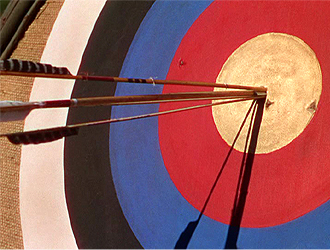
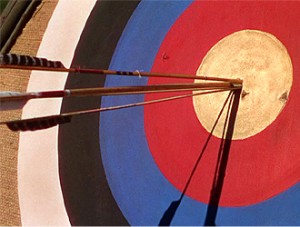
Although it is said that the tournament-winning arrow splits the other arrow in two, in fact when the arrow shot by Howard Hill strikes the arrow embedded in the target, it splits the arrow into three pieces. It sounds better to split something in half or in two, but the details in the movie are real and not just a saying.
One of the original story concepts had Robin Hood die at the end of the film.
The ending that exists now in the film is not the one that was originally written. In the original ending, King Richard and his forces help battle Prince John’s and Guy of Gisburne’s forces outside the castle – this ending was scrapped because it was too expensive to film. In the back-up ending, Prince John and Guy of Gisbourne’s forces chased Robin Hood’s and King Richard’s forces into Sherwood forest and the climax took place there. This second ending was really never satisfactory, and was scrapped too. Finally, a third ending was written, in which the climactic battle takes place inside the Castle of Nottingham. Now King Richard’s forces could be pared down to a handful of faithful retainers, and the new ending proved to be less expensive to shoot. To prepare the audience for the new ending, the abbot’s scenes were given to the Bishop of the Black Canons.
A scene was filmed that was to have taken place before the scene where Will Scarlet comes riding into the forest clearing with Much the Miller’s Son on his saddle. This was the scene where King Richard challenges Friar Tuck to a fistfight and wins, after which Robin himself agrees to fight King Richard. The scene was deleted from the final version of the film, making it appear that King Richard and Robin are about to fight for no reason.
— Don Jan