Oui Oui? Ou Non Non?
November 25, 1950
The Mail – Adelaide, South Australia

…
November 14, 1950
The Argus – Melbourne, Victoria


* Danielle Dervin may not have been her true name. Her true name may have been Danielle Duvivier.
— Tim
Oui Oui? Ou Non Non?
November 25, 1950
The Mail – Adelaide, South Australia

…
November 14, 1950
The Argus – Melbourne, Victoria


* Danielle Dervin may not have been her true name. Her true name may have been Danielle Duvivier.
— Tim
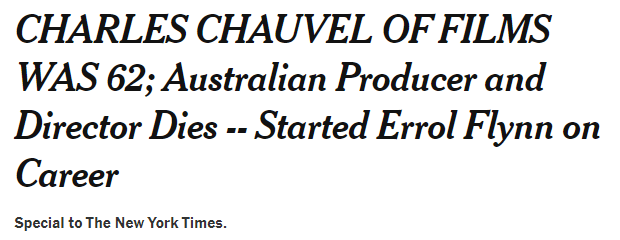
New York Times — November 12, 1959

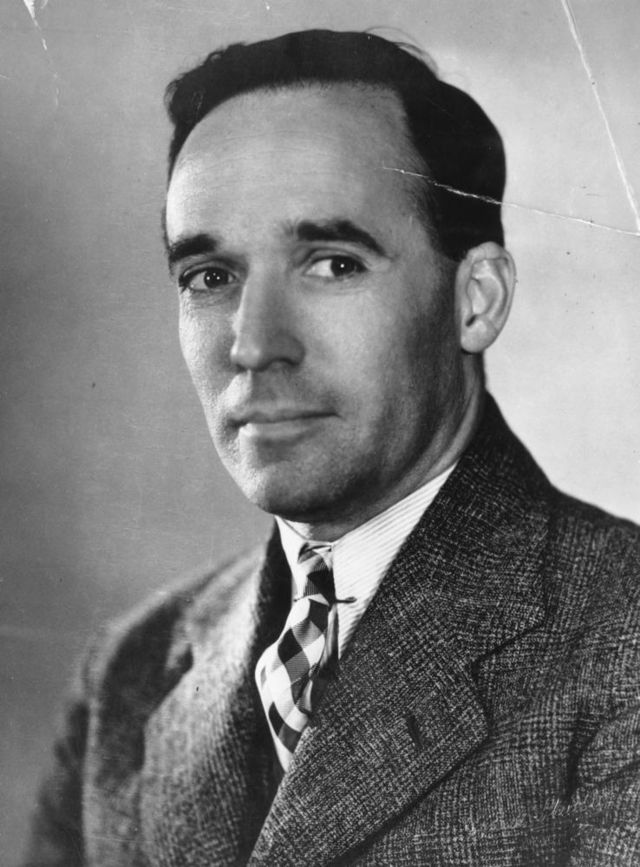
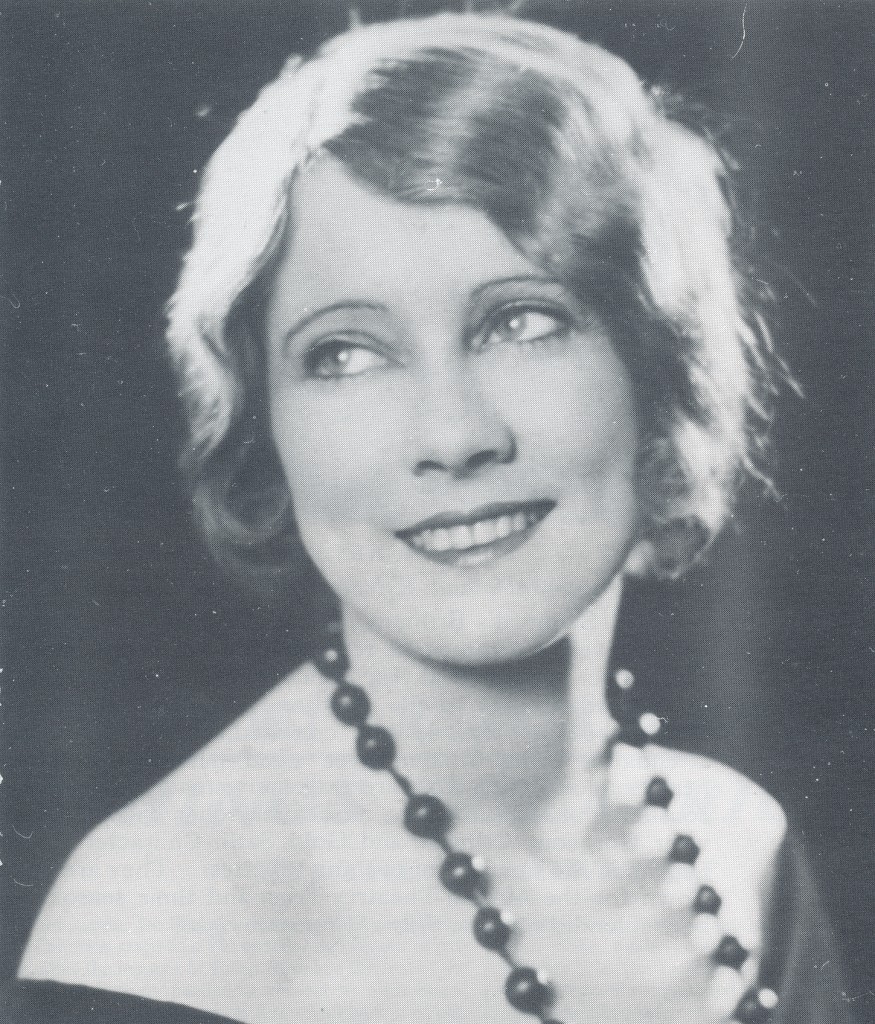
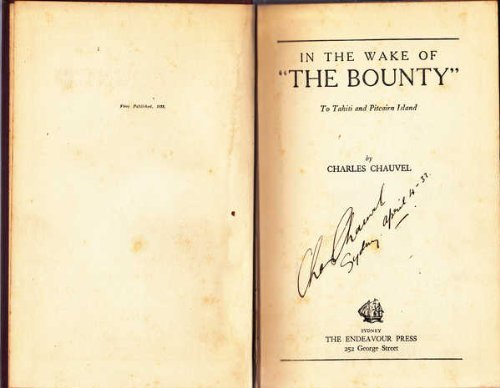
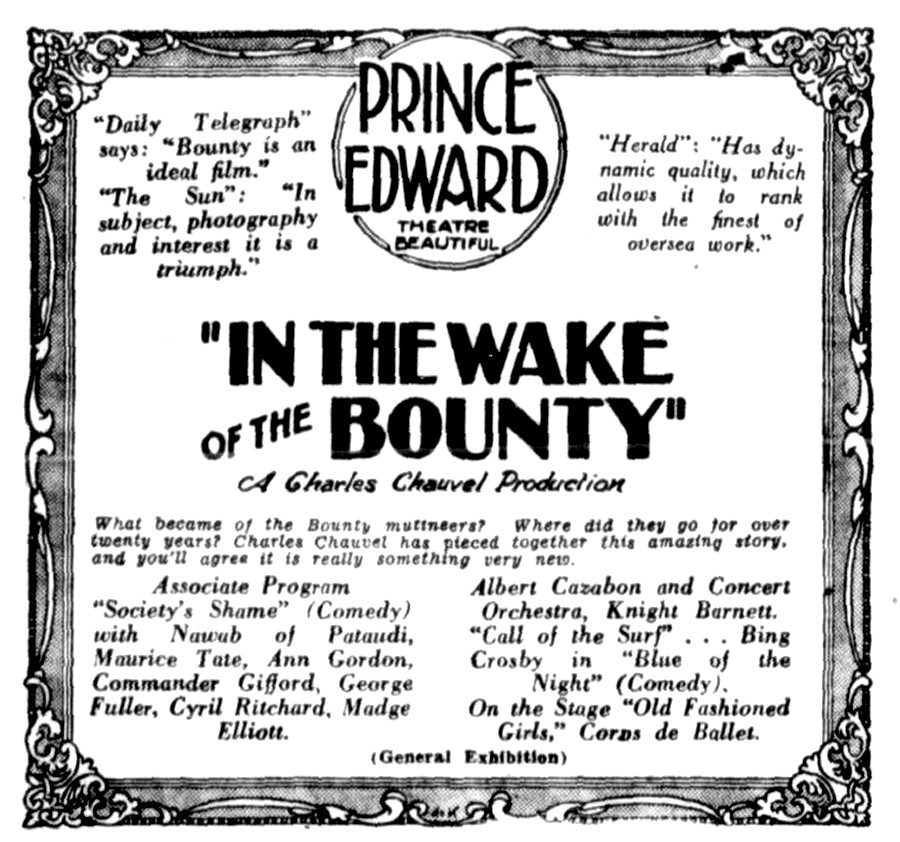
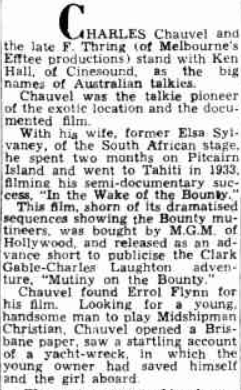
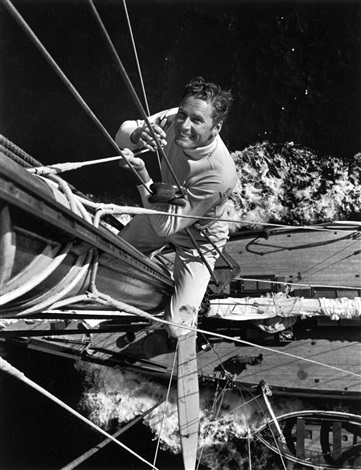
Charles Chauvel was both a producer and director, wrote his own scripts and handled casting and a great deal of the publicity. After marrying Charles, South African actress Elsie Sylvany changed her name to Elsa Chauvel and became an instrumental part of Charles productions, handling make-up, continuity in the early films, and later co-writing scripts. Their first sound film “In the Wake of the Bounty” gave Errol Flynn his first screen role, as Fletcher Christian of the Bounty, and was filmed on Tahiti and the remote island of Pitcairn.
Charles Chauvel

(Gorgeous) Elsa Chauvel

In the Wake of the Bounty – The Book

Premier at the Prince Edward Theater in Sydney

How Errol was discovered by Charles Chauvel. …An alternative account, often regarded more accurate, is that Errol was brought to the attention of Chauvel by John Warwick,an actor in the film, who apparently was impressed at Bondi Beach by Errol physique, charisma, and charm, and brought him (possibly to a casting session) to see Chauvel. There has also been a humorous account I heard many years ago – perhaps started by Errol himself – that, in order to get the role of Christian, he deliberately punched and broke the nose of the actor already slated for the role in a Sydney saloon the night before filming began.

— Tim
Here are a few discoveries about Miss Amelia Oliphant which appear in Errol MWWW.
Me and Bonnie Paraschos found a few interesting facts.
Olivia de Havilland played a role named Amelia in 1940 “my love came back”.
The River Queen was used in the movie Gone with the Wind (under a new name) and Oliphant means “olive branch” and is a Normand lastname.
We think Amelia is Olivia.
❤ open to discussion obviously
— Selene Hutchison-Zuffi

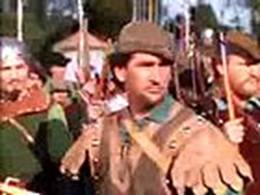
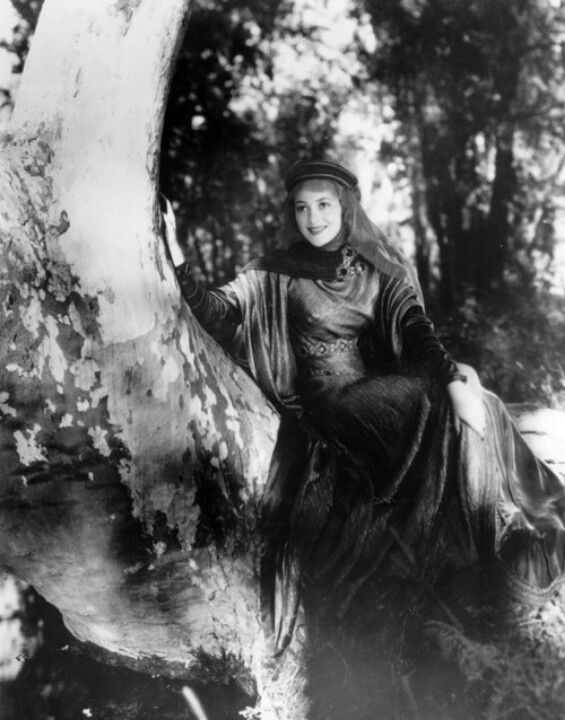
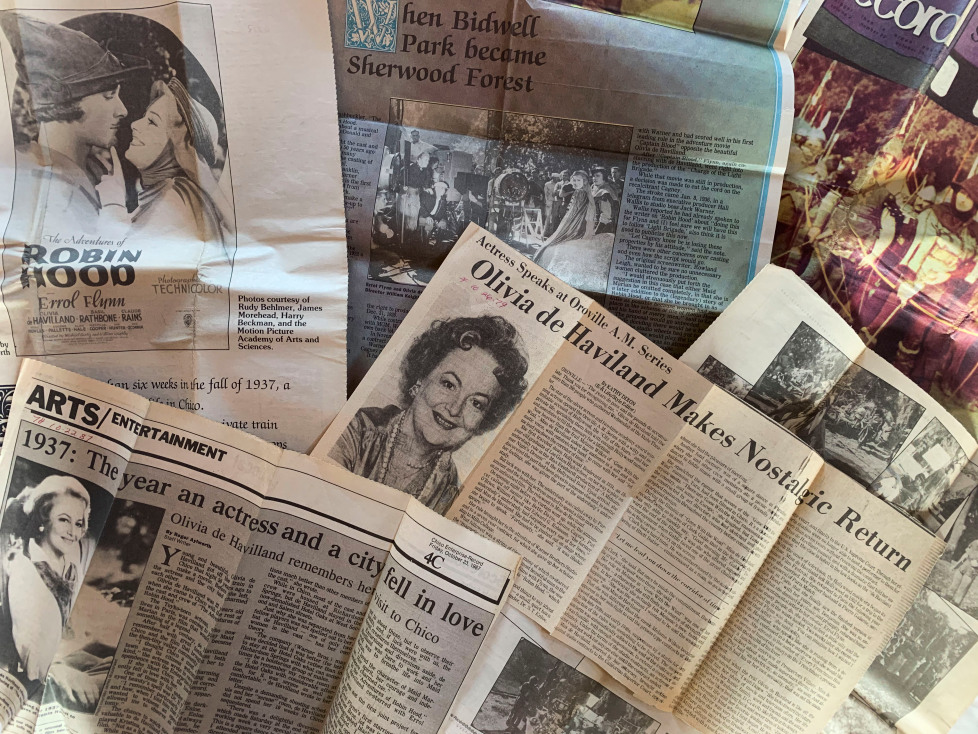
Olivia de Havilland starred as Maid Marian in the 1938 “The Adventures of Robin Hood,” which was filmed in fall of 1937 in Bidwell Park in Chico. (Enterprise-Record files)
Chico was charmed by Olivia de Havilland, and she by Chico. She graced Bidwell Park in the form of Maid Marian, but it was not Bidwell Park. It was Sherwood Forest in the 1938 classic “The Adventures of Robin Hood.”
It was in late September 1937 that she descended the train into Chico as a 22-year-old. The trees were aflame with orange, red and yellow tinges.
The train held not only her, but all the stars, technicians and props Warner Bros. needed to create a miniature Hollywood set on the banks of Big Chico Creek.
“I thought Chico a most charming town and its citizens welcoming and kind,” de Havilland wrote in a 1987 correspondence with the Chico Enterprise-Record from Paris.
The headquarters were set up in the form of tents by Sycamore Pool. Bidwell Park became a medieval forest.
According to a Sept. 15, 1937 Chico Record clipping, the park had been discovered by a Warner Bros. location scout and film director William Keighley.
“There was no location in California that could compare with Bidwell Park. I can’t understand why Chico has not been discovered before as a site for movies. I must confess my ignorance,” Keighley said.
“When Robin Hood was named for production, I thought a trip to the East or at least the Midwest would be necessary. I did not have any idea that anything such as Bidwell Park existed.”
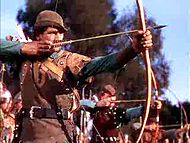
More than 100 extras were hired for $10 a day. If someone was willing to let actor and famous archer Howard Hill shoot their padded body with an arrow, they could earn an extra $150 a day.
The film had an original budget of $1.25 million, yet it rounded the $2 million mark, making it the most expensive film Warner Bros. had produced to that date.
In an October 1987 interview with this newspaper, the late television director and producer Rudy Behlmer said, “(de Havilland) was so beautiful then, the rest of the cast, the breadth of the staging. There wasn’t anything you could point to and say, ‘Well, that didn’t work very well.’”
One reason the aesthetic was so appealing was the new three-strip Technicolor process used to create it. Three separate strips of film were exposed simultaneously in the same camera, providing rich color on screen.
“This was the best example of that early Technicolor process with the forest scenes and the costumes and so on. And it is still considered one of the best examples of Technicolor,” Behlmer said.
After six weeks of shooting, de Havilland, as well as the rest of the crew, left Chico on Nov. 9, 1937, to the sight of 500 well-wishers gathered at the train station to bid them adieu. The Chico High band played music for them. The north section of Ivy Street was named Warner Street to commemorate the time of production.
It wasn’t until May 1938 that “The Adventures of Robin Hood” was released to great critical and popular acclaim. On May 14, 1938, it arrived at the Senator Theatre for a three-day run.
The actress came back to Butte County in October 1979 to speak at the Oroville State Theatre.
She remembered Chico as a small, quiet town with an “adorable little hospital.”
A 1987 E-R clipping said that one of the many locals to “fall under the dark-eyed beauty’s spell” was Doctor Newton Thomas Enloe, the founder of Enloe Medical Center. He let de Havilland witness an operation firsthand after she kindly asked.
She and other cast members attended square dances in Paradise on the weekends. The fiddle music delighted them, as did the hospitality of the locals.
“A very kind local gentleman taught me the steps and I joined in with immense pleasure,” de Havilland recalled.
During her stay in Oroville, her motel room was broken into. The doing was not that of Robin Hood. It was at 10 a.m. at the Villa Motel (now Villa Court Inn) that $4,959 worth of clothing and jewelry were stolen and the rest of her belongings scattered about.
Even so, she showed her gratitude to the audience for having her.
“Thank you for recognizing me,” she said.
De Havilland’s acting prowess, among other things, created a fairy tale out of Chico that, like her impact on Hollywood, lasts to this very day
— Tim
September 26, 1935
Harrison Carroll
LA Evening Herald Express
Lili Damita and Errol Flynn already have had twins named after them.
The papa is Louis Verdi, an extra on the Captain Blood set
— Tim

September 22, 1946
LOS ANGELES
SPECIAL TO THE MINNEAPOLIS TRIBUNE
Men, Women and Yachts Don’t Mix
Errol Flynn is reported by some quarters to be a direct descendant of Fletcher Christian, the man who started the mutiny on the Bounty. Mrs. Nora Eddington Flynn, his youthful bride, is believed in other quarters to be a direct descendant of Capt. Bligh, the commander of the Bounty. The other quarter in the case of Mrs. Flynn is John Decker, artist, who comes to this conclusion in explaining the “mutiny” on Flynn’s yacht Zaca while cruising the Pacific off Mexico. Decker and three others of the ship’s personnel left the Zaca at Acapulco, Mexico, because, Decker asserts, Nora had taken on some of the characteristics of a bucko mate in the old days when the clippers sailed around the Horn.
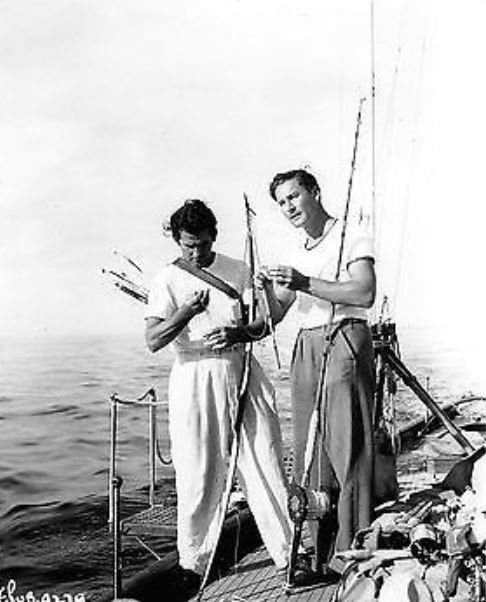
AMONG TILE SHIP’S COMPANY WHEN THE ZACA SAILED. This junket was a combination pleasure-science-professional affair. Flynn wanted to get away from Hollywood. He bought the Zaca last October, as a successor to the Sirocco, where there had been many gay parties which, perhaps, Flynn wanted to forget. To make it all serious, he was going to collect marine specimens. There were 17 aboard when the yacht sailed, and a representative group they were, indeed. There was Dr. Theodore Thomson-Flynn, Errol’s father, who is a zoologist and dean of the school of science at Queens college in Belfast, Ireland. And there was Prof. Carl Hubbs of the Scripps Institute of Oceanography at La Jolla, Calif., a noted ichthyologist. Tanks, torch lights, tackle arid enough formaldehyde to pickle half the fish in the ocean. Prof. Hubbs could be dropped blindfold into any part of any sea and tell at once where he was by examining the local fish.
Ted Stauffer, a Swiss composer and erstwhile night club operator in Mexico City, was also aboard. Stauffer took along a camera, planning to make magazine pictures. Howard Hill, the famed toxologist, and Jerry Courmoyay also were present. They planned a color picture of the trip, featuring Hill s archery and the various flora and fauna encountered on the way. Chris Duke and Kurt Hartzog, two Hollywood bit players, were included in this part of the project.
DECKER CAN PAINT. And then there was Decker, really a great painter, who figured on getting a lot of marine life into color. Decker has painted some pretty queer fish in his time and this wouldn’t be a novelty. He hit on a highly-appreciated medium some years ago when he began copying the old masters and putting actors’ faces on them. Two of his most famous in this line are Queen Victoria with the face of W. C. Fields and the famed Blue Boy of Gainsborough with Harpo Marx’ pan. In serious vein, Decker has taken numerous prizes at exhibitions. There were also a professional captain and two working sailors, named Wally Beery (not the actor) and John Vincent. And, in addition, Nora.
NORA GETS HER SEA LEGS. They had been gone nearly a month when the ketch-rigged schooner hove-to at Acapulco, where almost at once it became apparent that there had been a clash of personalities aboard. The main narrative from now on is that of Decker.
THE CRISIS NEARS. It was while they were hanging around Socorro that Decker detected the growth of a quarterdeck manner in Nora. Once, he said, she directed the guests if you could call them guests to pick up their coffee cups after a meal on deck and carry them back to the galley. Another time, life went on, several of the ship’s company were sitting in the saloon and Nora said: ‘Everybody get up on deck.” Anyway, things came to a 5- head right there in Socorro lagoon. Seaman Berry dived into the water “with a spring harpoon gun. He was going after a shark. But instead of harpooning the shark he harpooned his own ankle. The harpoon has a nasty barb and the wound was serious. Dr. Thomson-Flynn and Prof. Hubbs operated on the leg and removed the weapon. However, there seemed to be some danger of infection and Decker finally persuaded Flynn, over Nora’s protests, to proceed to Acapulco, 1,000 miles away and the nearest spot for competent medical aid. So, once in Acapulco, Decker marched ashore with the wounded man, and stayed ashore. Duke and Hartzog, the film players, left with him. He emphasized that his relations with Flynn remained friendly.
FOUR-LETTER WORDS Nora’s comment on all this was that the amateur sailors expected to be treated as guests [rather than working crew.] This was very unsatisfactory, she remarked in a phone conversation with her father.
NORA AND ERROL, ABOARD HIS YACHT. Actor Flynn has always had a yen for the sea. “Women, men and yachts don’t mix,” he said. “Just as soon as Nora got her sea legs she took over command of the boat and started shoving everybody around. I’ve known her ever since she married Flynn but I never really had any conversation with her. The talks I had with Flynn were man talks, and she couldn’t enter into them, so I never really knew her until I went on this boat. “It’s too bad this little mosquito has come between Flynn and me. I can’t really lay my finger on anything important she did. It was a constant pin-pricking process calculated to wear me down. “She greeted me with lhe remark when I went aboard at Santa Monica: ‘You’re not serious about going on this trip? You must be kidding.’ I told her I was serious and I wasn’t kidding and her face fell a mile. “She began at once to make things disagreeable for me, blaming me for everything that went wrong, always yelling around the boat when anything was out of the way: ‘Oh, that’s Decker.’ ” The yacht stopped at Cedros Island, off the coast of Lower California, and then proceeded to the Revilla Gigedo Islands, southeast of the tip of Lower California and pretty well out in the Pacific. The serious fishing began at Socorro Island in that group. Dr. Thomson-Flynn and Prof. Hubbs are dedicated scientists. They have loaded the boat with dredges.
Decker insisted he was right in using four-letter words. Nora has won this time, anyway, if it was her aim to get Decker off the boat. Flynn plans to continue through the canal and to Europe. At present he is trying to assemble a crew of experienced hands for the trip across the Atlantic. All the fuss could be, of course, a vagary such as is often attributed to expectant mothers, who are known to ask for things like strawberries out of season and the like. Nora is expecting another child next March. And, anyway, her influence will soon be gone. She expects to leave the yacht in the West Indies and fly back to Hollywood.
— Tim

HOLLYWOOD –
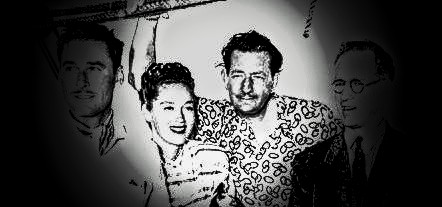
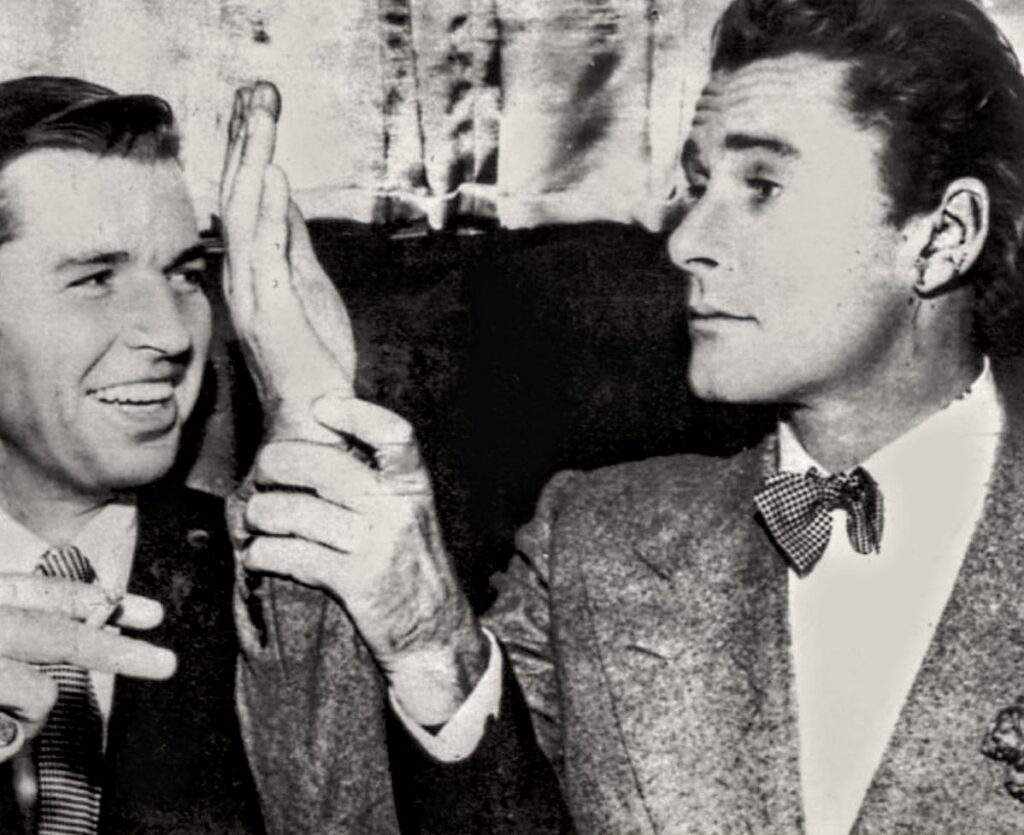
On September 20, 1941, Errol engaged in one of the most notorious nightclub fights in Hollywood history when he slapped gossip columnist Jimmie Fidler, whose wife then stabbed Errol in his ear with a fork. Below are excerpts and summaries from various accounts of :
“All the blood came from the veins of Flynn. He charged that Fidler’s wife, Bobbie, stabbed him in the ear with a fork. Movie celebrities at surrounding tables in the Club Mocambo verified his story of Mrs. Fidler’s use of her fork as a fencing foil. The Fidlers were sitting with Samuel Zagon, Hollywood attorney, and his wife, when Flynn and Bruce Cabot walked into the celebrity-jammed room. Flynn spied Fidler, called him names, and started to poke him. Tables were overturned. Fidler’s coffee was decorating his shirt front. His wife was screaming. Blood was squirting from Flynn’s ear lobe and a dozen men were grappling with the fighters. The scene resembled the riot of stunt men in the night club sequence of many a Flynn movie. The manager was about to cell the cops when Phil Ohman’s band struck up “the Star Spangled Banner” and all hands stood at attention, dribbling blood, sweat, and rose buds from the overturned vases of one of Hollywood’s most expensive drinkeries. The gladiators retired to pose for photographs and issue statements.”
…
“I put my left fist up against his chin and gave him a slap with my right hand on the side of the head. I said ‘You’re not worth a fist.’” But then “his wife became angered and I tried to hold her to one side, still gripping Fidler, but finally she jabbed at me with a fork, which would have stuck me in the eye had I not turned my head. Instead it pierced my ear. I must say that I admire Mrs. Fidler, God bless her. She has the courage to try to defend her husband — much more courage than he himself has.”
…
“I slapped him. In Ireland that’s tantamount to the worst insult a man can give another man … I want to add, however, that [Mrs. Fidler] showed bad etiquette and used the wrong fork — she should have used the entree fork.”
…
“Fidler claimed Flynn had come over to the table, ran his mouth, tried to punch him, lost his diamond cuff links in the process, accused Fidler of stealing said cufflinks, gone back to drinking, taken a lady to the dance floor, passed his seat on the way there, and up and tried to punch him again.”
“And when things were just about to get real, the band leader started into “The Star-Spangled Banner.”

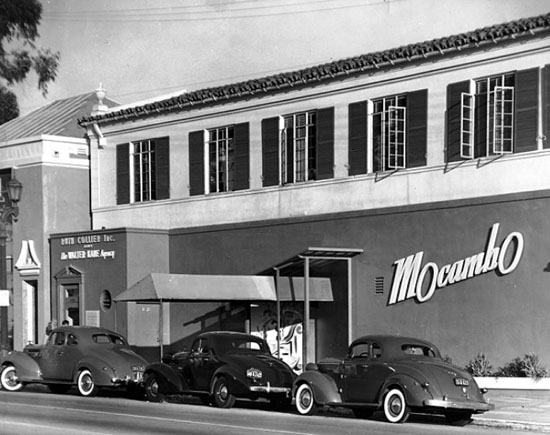
“Like the Cafe Trocadero and Ciro’s, the Mocambo was a world-famous nightclub on the Sunset Strip catering to celebrities. Located at 8588 Sunset Blvd. [map], it opened on January 3, 1941, featuring Mexican-themed decor said to have cost over $100,000 (about $1.6 million today) and dominated by glass-walled aviaries that housed live macaws, cockatoos, parrots and other birds.
During its 17-year run, the Mocambo was the scene of a number of celebrity brawls. In 1941, a movie agent named William Burnside cold-cocked restaurateur Michael Romanoff there, for reasons now forgotten. “I wish they had let me go just for a minute and I would have annihilated him,” Romanoff said later. In October that year, Errol Flynn punched Los Angeles Times columnist Jimmy Fidler at Mocambo in retaliation for purported derogatory comments Fidler had made in his column.
…
Phil Olman was a premier pianist, first in New York performing and recording with George Gershwin, Irving Berlin and Paul Whiteman, et al. Then he left for the left coast, where he specialized in teaching actors and pianists how to play piano in Hollywood films, in addition to recording and playing the top celebrity nightclubs. He is known for songs like “I Love a Parade”, “Penthouse Serenade”, “Funny Face”, “Each Time You Say Goodbye [I Die a Little]”, and many, many more. Unfortunately, I could not find any recordings of him playing the Star-Spangled Banner!
— Tim
September 5, 1980 / May 1942


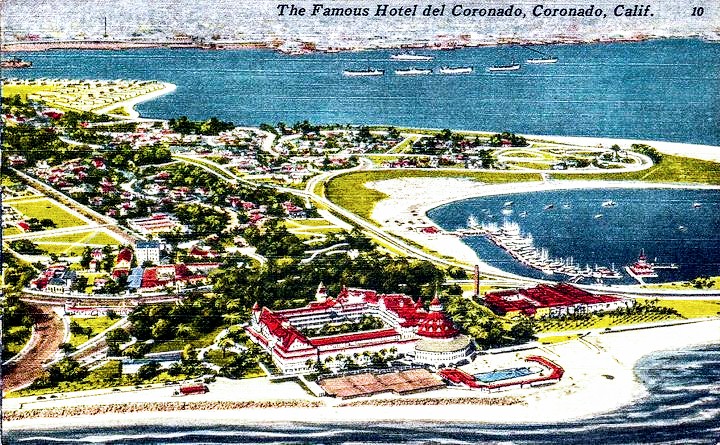
Errol Flynn’s Antic Stay at the Hotel Del Coronado
Excerpt from Esquire Magazine, May 1942. The Writings of Errol Flynn. “It Shouldn’t Happen to an Actor”
Friendship with Arno meant you were a cinch to lose most of your friends. There were times when the only answer seemed to be to change my name or leave the country. Like that time at the Coronado Hotel The Coronado Hotel is an austere establishment where rich old folks go to play until they die. The waitresses get off weekends to visit their grandchildren. You are kept awake nights by the dull thud of guests dropping dead.
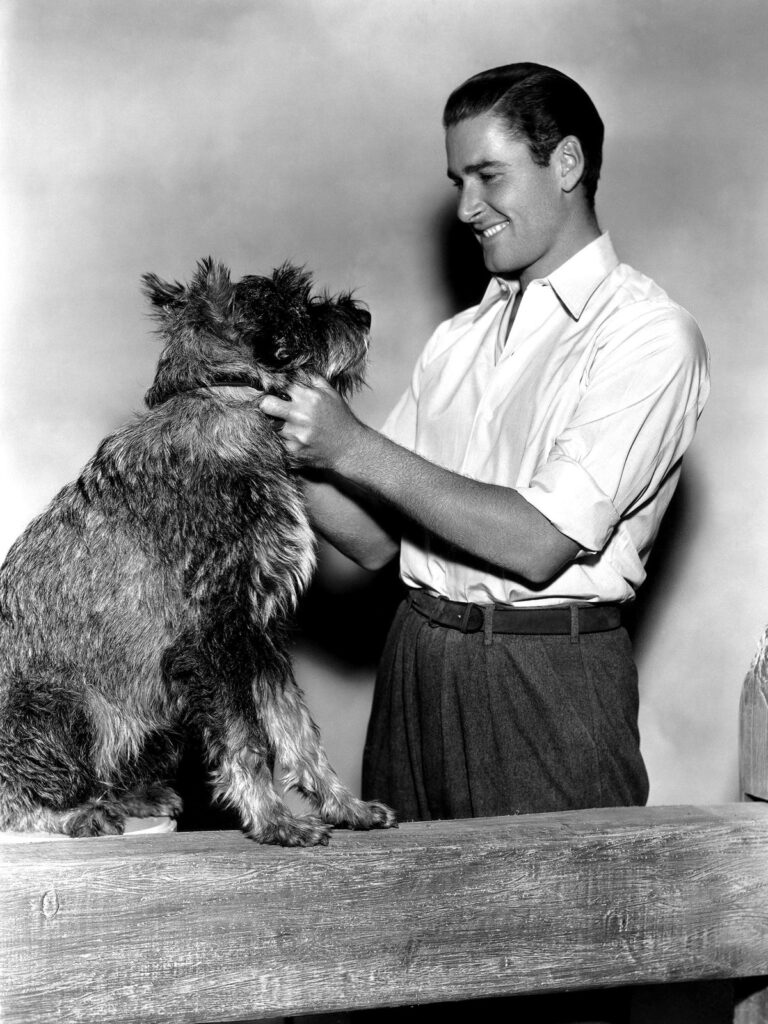
Disaster, ever Arno’s sidekick, struck one day in the dining room of that hotel. Eating was always a problem because Arno insisted on eating with me. If you chased him out of the restaurant, he would just come in another door. When the door was shut he would wail for some customers and come in again camouflaged between their legs.
On this particular day I had (I thought) double-locked him in my room upstairs. One of the hotel’s younger set – a quaint little thing of about seventy – always complained that the dining room was cold, in spile of the temperature being a good eighty. She also maintained it was so dark she couldn’t see, though you could take snapshots in there at night and they would have been overexposed. So she announced she would provide her own lighting. Soon a tall stand-lamp arrived and was installed behind her chair. When lit the first night it was found to contain a 200-watt bulb of such brilliance that it temporarily blinded everyone who looked in her direction. The waitresses were the ones who suffered most They would serve her something and turn around to get something else, and everything would immediately go black. They would usually drop whatever they were holding. One of them partially solved the problem by wearing dark glasses. Of course nothing much could be done about the heating arrangements. From the heat generated by her lamp, people at adjoining tables already perspired freely throughout meals, but the frail little old lady sat serenely under her 200-watt umbrella and remarked how cold she was. She . finally achieved some measure of comfort by coming into meals wearing several silver fox furs. This was partly the cause of the trouble.
One night I was sitting in the dining room over a bottle of wine when a cat passed by the table. I knew this cat slightly. He was a prosperous executive-looking kind of cat and apparently had the exclusive use of the kitchen and dining room. Business was good with him. Suddenly there was a commotion at the dining room entrance. There was a scraping of chairs; the head waiters began moving around agitatedly. The hair on the back of the business cat shot up as though someone had got by the secretary he didn’t want to see.
It was Arno. How he got out of the room I don’t know. He had just started to give me a brief nod, a sort of double take, when he saw the cat. That was enough! They broke beautifully from the gate without a second’s difference in the start hugging the rail the cat skidded around several tables three lengths ahead of Arno. At the far turn, Arno had shortened and was coming up on the outside. Coming into the stretch it began to lode like a photo finish when the cat taking a desperate gamble, swerved sharply under the frail little old lady’s table. Arno, trailing by barely half a length now, saw dangling in front of him the fox fur and! It was horrible.
The screams of the waitresses, the hoarse shouts of the men, the smash of crockery, rose to a sudden deafening explosion as the 200-watt lamp crashed to the floor and broke shivering into a thousand pieces. Arno had the little old lady’s silver fox fur by the throat in a killer’s grip. On dark nights, the sounds still ring in my ears. All in all, the hotel was very nice about it After I had paid for the damage the management said I could come and stay there practically any time – alone.
…
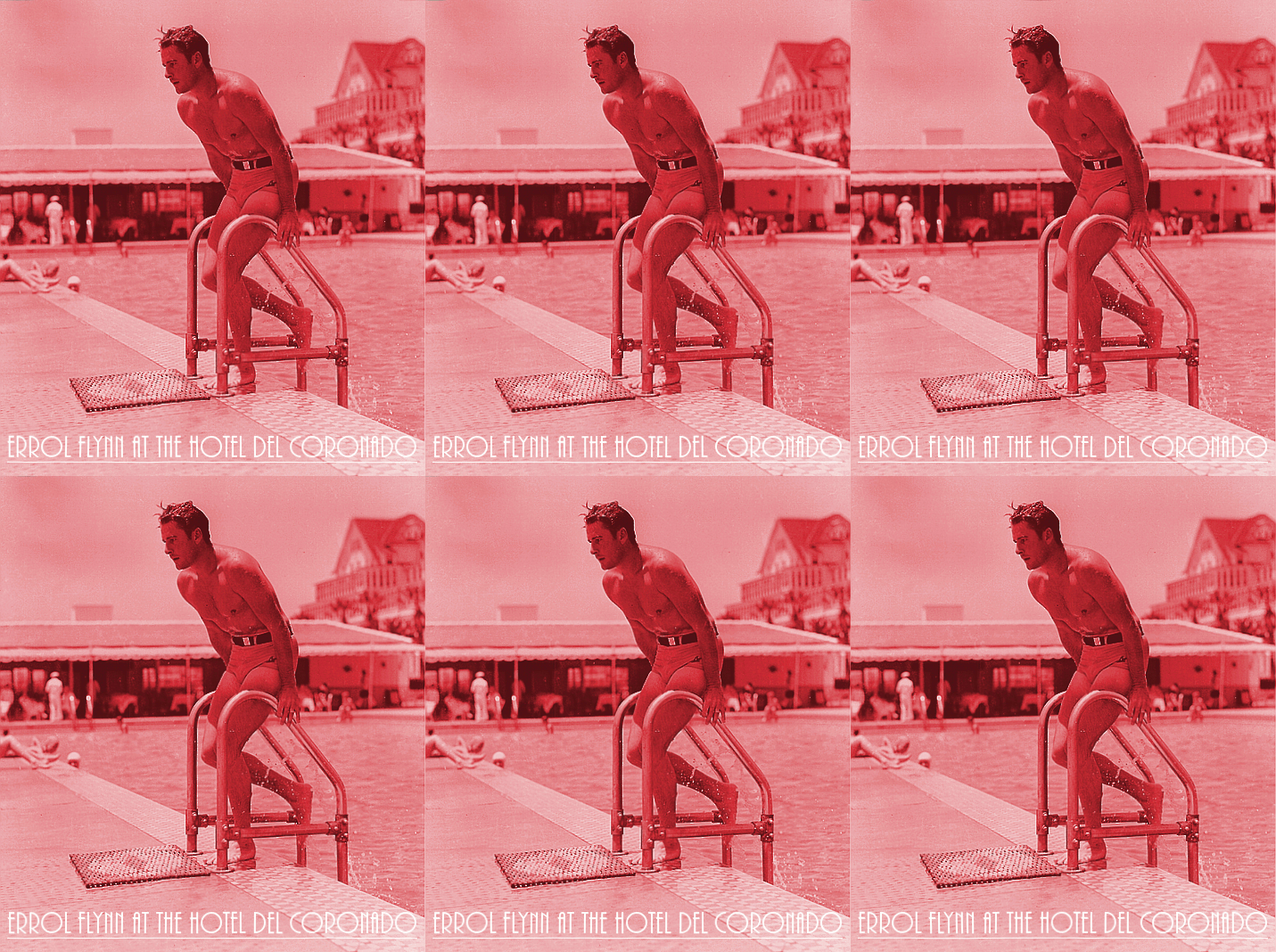
Here’s Errol at the Hotel Del pool … sans Arno

— Tim